
Vapor Intrusion Screening Levels report compares your measured concentrations against two sets of numbers. Indoor air results go against vapor action levels, written VALs. Everything collected below ground, meaning sub-slab vapor, soil gas, and groundwater, goes against vapor risk screening levels, written VRSLs. An attenuation factor is the multiplier that connects the two.
In Wisconsin those numbers come from a state lookup table rather than straight from EPA, and the difference between the two is larger than most people expect.
Table of Contents
What a vapor action level is
A VAL is an indoor air concentration, set separately for each chemical, above which the state expects something to happen. It is not a pass or fail line in the way people read it. It is the point at which the conversation moves from monitoring to acting.
VALs vary by building use, because exposure assumptions vary. A residential VAL assumes someone is present most of the day, most days. A commercial VAL assumes a working shift. Wisconsin’s table carries separate values for residential and for commercial and industrial settings for this reason.
Each VAL is derived twice, once for cancer risk and once for non-cancer health effects, and the lower of the two becomes the published value. For most of the compounds that drive vapor intrusion work, the cancer calculation is the one that governs.
| Term | Applies to | What it means |
| VAL | Indoor air | Vapor action level. The concentration in breathing air above which action is expected |
| VRSL | Sub-slab, soil gas, groundwater | Vapor risk screening level. Derived from the VAL by applying an attenuation factor |
| AF | The relationship between them | Attenuation factor. How much a subsurface concentration is reduced by the time it reaches indoor air |
What a vapor risk screening level is
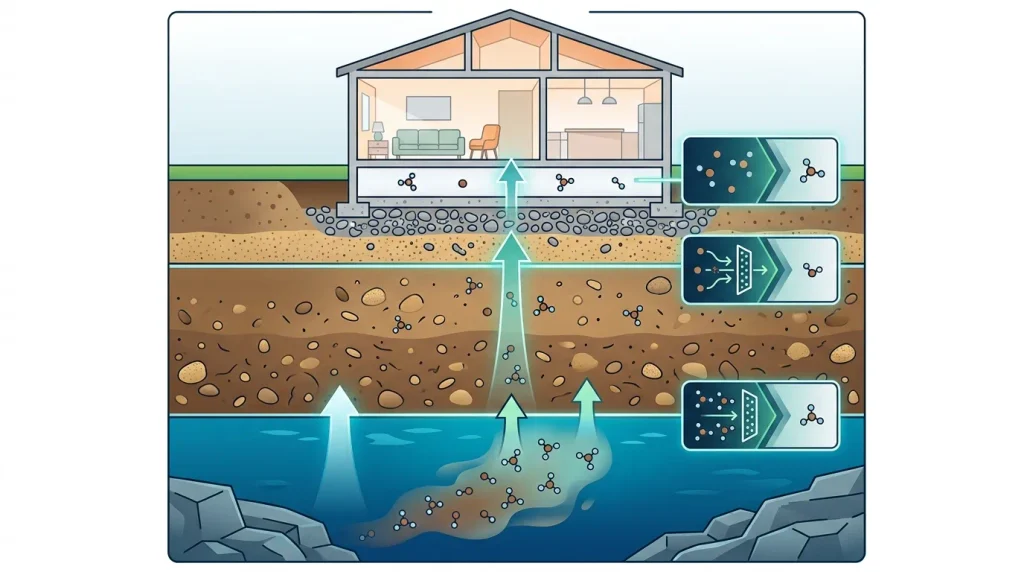
You cannot act on a sub-slab number directly, because nobody breathes sub-slab air. A VRSL translates a subsurface measurement into the question that matters: if this concentration is under the building, is the indoor air likely to exceed the VAL?
Wisconsin publishes VRSLs for sub-slab vapor, soil gas, and groundwater, broken out by building category. The sub-slab tables distinguish residential, small commercial, and large commercial or industrial buildings, because building size changes how much dilution occurs. The groundwater tables add a further variable, since the depth between the water table and the foundation affects how much attenuation happens on the way up.
How attenuation factors connect the two
The attenuation factor is the whole mechanism, and it is simpler than it sounds.
EPA’s default assumption is that a sub-slab or near-source soil gas concentration arrives in indoor air at about three percent of its original strength. That is an attenuation factor of 0.03. For groundwater the default is far smaller, 0.001, because the vapor has to leave the water, travel up through soil, and then get through the foundation.
Run the arithmetic and the implication becomes obvious. If a chemical’s indoor air VAL is some value, the sub-slab VRSL is that value divided by 0.03, which is roughly 33 times higher. This is why a sub-slab result that looks alarmingly large next to an indoor air number can still be under its own screening level. The two are not measured against the same yardstick and never were.
The most common misreading of a vapor report: comparing a sub-slab concentration against an indoor air action level. They will always look terrible. Check which column you are reading before you panic about a number.
Wisconsin’s table goes further than a single default. It publishes attenuation factors for five screening media at three different separation distances from the foundation, which allows a more realistic comparison where the distance between contamination and building is known.
Why Wisconsin’s numbers differ from EPA screening levels
This is the part worth reading twice, and it is where searches for EPA vapor intrusion screening levels can lead people astray.
EPA’s Regional Screening Levels are published at a target cancer risk of one in a million, meaning one additional cancer case per million people exposed over a lifetime. Wisconsin does not adopt that figure for vapor. Under the state’s vapor guidance, VALs for carcinogens are set at a target cancer risk of one in a hundred thousand, which is ten times less stringent. Non-carcinogens are not adjusted and stay at a hazard quotient of 1.
So a consultant comparing Wisconsin vapor data against EPA’s published residential air RSL table, without adjusting, is applying a value ten times tighter than the state actually requires. That produces exceedances that Wisconsin would not call exceedances, and it can drive decisions that were never necessary.
The reverse mistake is rarer but worse. Assuming Wisconsin is more permissive across the board is wrong, because the state does not relax anything for non-cancer endpoints and applies its own attenuation factors and building categories on top.
The practical takeaway is to use the Wisconsin lookup table rather than EPA’s raw numbers for any Wisconsin site. The DNR publishes it as the Wisconsin Vapor Quick Look-Up Table, reference RR-0136, on its vapor intrusion resources page.
Which building category applies to your property?
Picking the wrong category changes the answer, and it is a genuine judgment call in mixed-use buildings.
| Category | Typical application |
| Residential | Homes, apartments, and any space where someone lives. The most protective category, because exposure is assumed to be near-continuous |
| Small commercial | Offices, retail units, and smaller workplaces. Shift-length exposure with a modest building volume |
| Large commercial or industrial | Warehouses, manufacturing, and large-footprint buildings. Greater internal volume means more dilution of whatever enters |
Mixed-use buildings are where this gets contested. Ground-floor retail beneath apartments generally means the residential category governs the parts of the building where people live, regardless of what the commercial space downstairs would qualify for on its own. If your report applies a commercial category to a building with residential occupancy above, that is a question worth raising with the consultant.
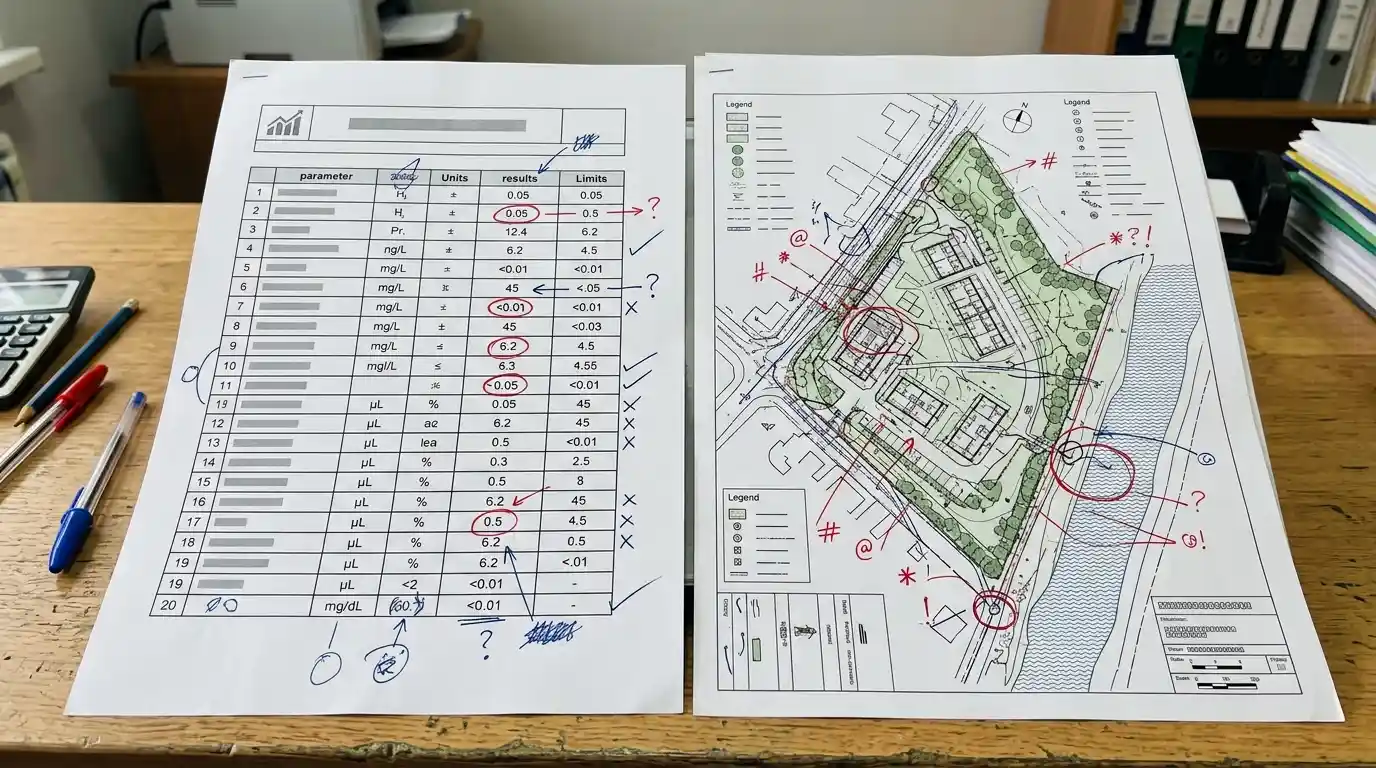
How to actually read your results table
Working through a report in order:
- Identify the medium for each sample. Sub-slab, indoor air, soil gas, groundwater, or outdoor ambient. Compare like against like, never across media.
- Confirm the building category used. Residential, small commercial, or large commercial. Check it matches how the building is actually occupied.
- Compare each result to its own screening value. Indoor air against the VAL. Sub-slab against the sub-slab VRSL. Groundwater against the groundwater VRSL.
- Check the outdoor sample. If a compound appears indoors at similar levels to outdoors, the source may be ambient air rather than the subsurface.
- Look at the reporting limits. A non-detect only means the laboratory could not see the compound above its detection threshold, which is not always low enough to be useful.
- Read the sub-slab and indoor air together. High sub-slab with clean indoor air points to an intact building envelope. Elevated indoor air with clean sub-slab points to an indoor source.
If you have not read how the samples were collected, our article on how vapor intrusion testing works covers the sampling side and explains several of the data quality issues that show up in a results table.
What if my chemical is not in the table?
The Wisconsin table covers compounds frequently encountered at cleanup sites in the state, not everything that exists. For anything outside it, the state directs users to EPA’s Vapor Intrusion Screening Level calculator, and RR-0136 contains instructions for doing that correctly.
Two adjustments matter when calculating a value that way. The Wisconsin cancer risk target has to be applied rather than EPA’s default, and the appropriate attenuation factor has to be selected for the medium and separation distance involved. Getting either wrong produces a number that looks authoritative and is not.
Why the numbers change, and what that means for old results
Screening levels are not fixed. They move whenever the underlying toxicity science is revised, which happens more often than most property owners realise.
Recent Wisconsin updates have included new inhalation toxicity data for individual compounds, and in at least one case an update lowered the action and screening levels for a chemical outright. When that happens, the DNR’s guidance to consultants is to compare existing vapor data at open sites against the updated table, because a result that passed under the old values may not pass under the new ones.
Wisconsin also publishes a history of changes document, reference RR-0137, which records previous values and the dates they changed. It exists so anyone reviewing an old decision can see which numbers were in force at the time. If you are looking at a report from several years ago and trying to work out whether its conclusions still hold, that is the document that answers it.
What an exceedance actually triggers
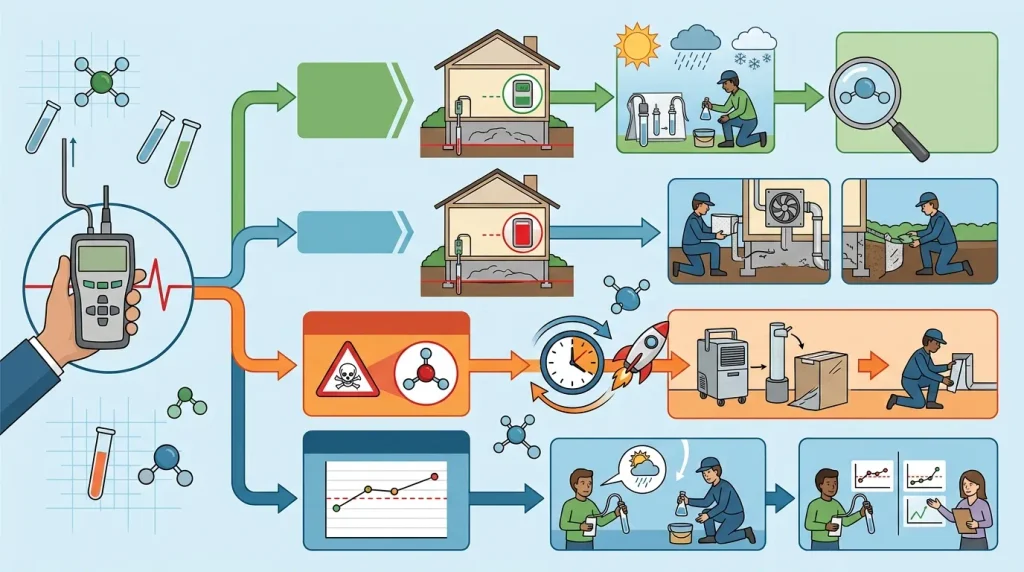
An exceedance is a trigger for evaluation, not an automatic order to install anything. What follows depends on which medium exceeded, by how much, and which compound is involved.
- Sub-slab above its VRSL, indoor air clean. Usually more sampling. The source is confirmed, the entry route is not, and additional rounds across seasons are common.
- Indoor air above the VAL. The exposure question is answered and mitigation enters the conversation directly.
- TCE above its action level. The timeline compresses sharply. Wisconsin treats TCE as an acute concern and allows interim action before a full investigation concludes.
- Marginal exceedance of a single compound. Often resampled before anything else happens, since a single sample is a snapshot and variability is expected.
FAQ
What does a non-detect mean if the reporting limit is above the screening level?
It means the laboratory could not see the compound, not that the compound is absent at a safe concentration. Where a reporting limit sits above the applicable screening value, the result is genuinely inconclusive for that chemical, and it should be flagged in the report rather than counted as a pass. The fix is a lower reporting limit, which usually means a longer sample or a different analytical approach. This is worth checking on any report where a key compound comes back clean.
Can a site-specific attenuation factor be used instead of the default?
Yes, and it is sometimes worth doing. The defaults are conservative generic values chosen to be protective across a wide range of buildings. Where enough building-specific data exists, a site-specific factor can be developed and applied, which often produces a more realistic comparison. It requires DNR review and agreement, and it needs supporting data rather than an assertion, so it is usually only pursued where the generic comparison is producing a marginal result.
Do my vapor results have to be reported to the DNR?
If the property sits within an open remediation case, results go to the assigned project manager as part of the normal reporting. Where sampling was commissioned privately outside any regulatory case, the position is different and depends on what was found and whether a reportable discharge is indicated. This is a question for your consultant and, where liability is involved, an environmental attorney.
My report shows an exceedance in one sample and not another in the same building. Which is right?
Both, probably. Concentrations vary spatially across a building footprint, sometimes substantially, because entry routes and sub-slab conditions are not uniform. A single elevated location usually indicates a preferential entry point rather than a bad sample, and it is useful information for system design. Averaging across samples to make an exceedance disappear is not a defensible approach.
Do older test results still count if the screening table has been updated since?
The measured concentrations remain valid. The conclusions drawn from them may not. If values have been lowered since the report was written, a result that passed then could exceed now, and at open sites the state expects consultants to make that comparison against the current table. The history of changes document exists precisely to let someone reconstruct which values applied when.
Does an exceedance have to be disclosed to tenants or buyers?
Tenant communication and transactional disclosure are different questions with different answers, and both depend on jurisdiction, lease terms, and contract. As a practical matter, occupants in a building being actively sampled usually become aware regardless, and handling that proactively tends to go better than being asked about it later. Get advice from an environmental attorney before making a formal disclosure decision.
Conclusion
Why TCE gets its own row is covered in our article on why vapor intrusion is dangerous, and the wider Wisconsin framework is covered in the vapor intrusion pillar guide.
If your results point toward mitigation, Milwaukee Radon Mitigation designs and installs vapor mitigation systems for commercial and industrial buildings across Milwaukee, Waukesha, and Ozaukee counties, working alongside your environmental consultant. See our vapor intrusion mitigation services, request a free quote, or call (414) 455-7279.