
Testing for vapor intrusion means collecting air samples from several places at once and reading them together. The core pair is a sub-slab sample taken from directly beneath the floor and an indoor air sample from the occupied space above it. Both go to a laboratory, and neither one answers the question on its own.
There is no meter you can walk around with. The concentrations that matter sit far below what any field instrument or consumer device can detect, which is why every step below exists to protect the integrity of a sample that will be analysed somewhere else, days later.
Table of Contents
How to test for vapor intrusion: the sequence
A defensible evaluation works from the source toward the receptor, and stops as soon as it has an answer.
- Review what is already known. Site history, regulatory files, and any existing groundwater or soil data. A great deal of screening ends here, because the records either rule the pathway out or establish that it needs looking at.
- Screen the subsurface. Groundwater results or exterior soil gas probes establish whether contamination is present and where it sits, before anyone drills a floor.
- Sample beneath the slab. Sub-slab ports measure what is actually under the building, which is the most direct predictor of what could get in.
- Sample the indoor air. Collected at the same time as the sub-slab samples, in the occupied space, alongside an outdoor sample for comparison.
- Evaluate the results together. Compare against Wisconsin screening values, account for indoor background sources, and decide whether more rounds are needed.
Skipping straight to indoor air is a common shortcut and a poor one. A positive indoor result with no sub-slab data cannot distinguish vapor coming up through the floor from a cleaning cupboard in the next room.
The four sampling media and what each one tells you
| Medium | What it measures | What it is good for |
| Sub-slab vapor | Soil gas concentration directly beneath the floor slab | The workhorse sample. Most direct predictor of potential indoor exposure |
| Indoor air | Actual concentrations in the breathing space | The exposure answer, but it includes background sources from inside the building |
| Exterior soil gas | Vapor in soil outside the building footprint | Mapping the source and its extent, and supporting decisions before drilling a slab |
| Groundwater | Dissolved contamination beneath the site | Early screening. Establishes whether a vapor pathway is plausible at all |
Outdoor ambient air is usually collected alongside indoor air as a fifth sample. It costs very little and it settles arguments, since some of these compounds exist at low levels in ordinary urban air.
What sub-slab sampling involves
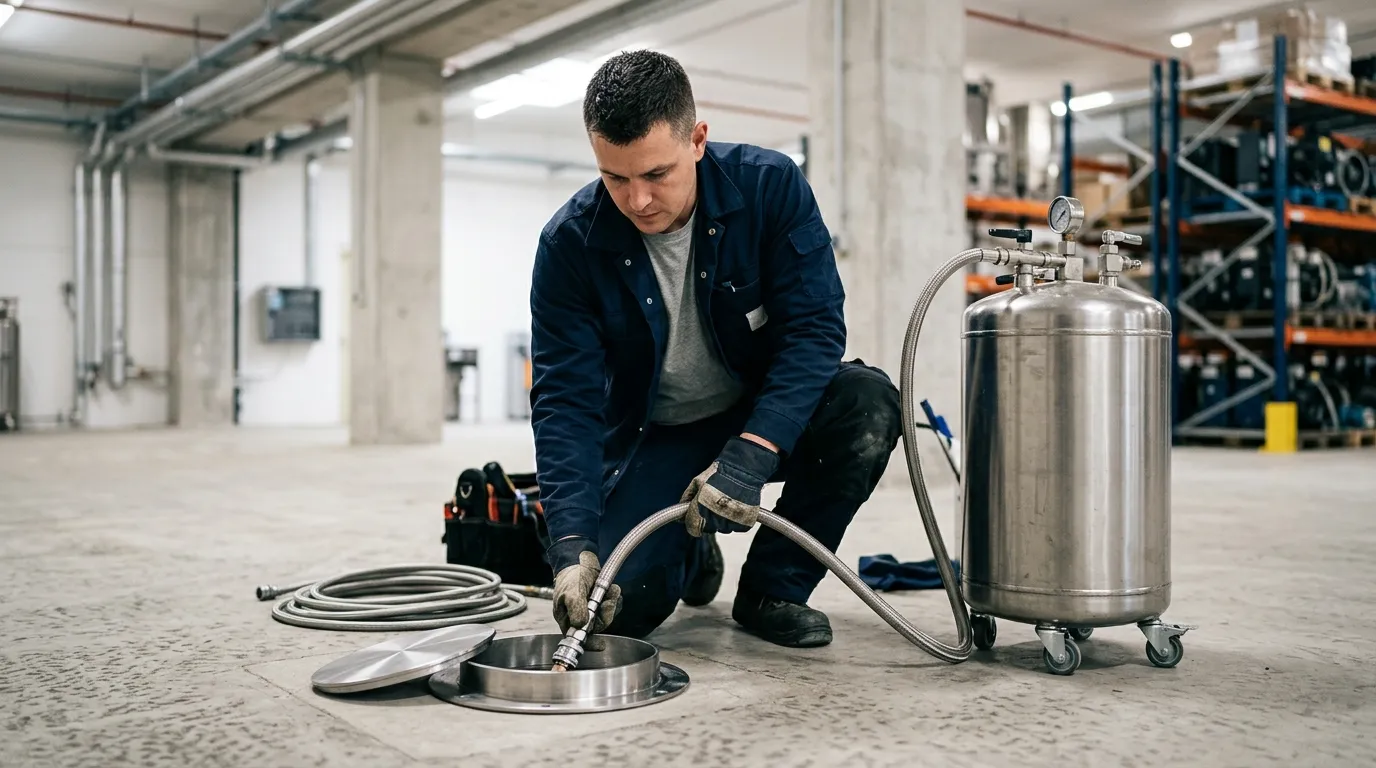
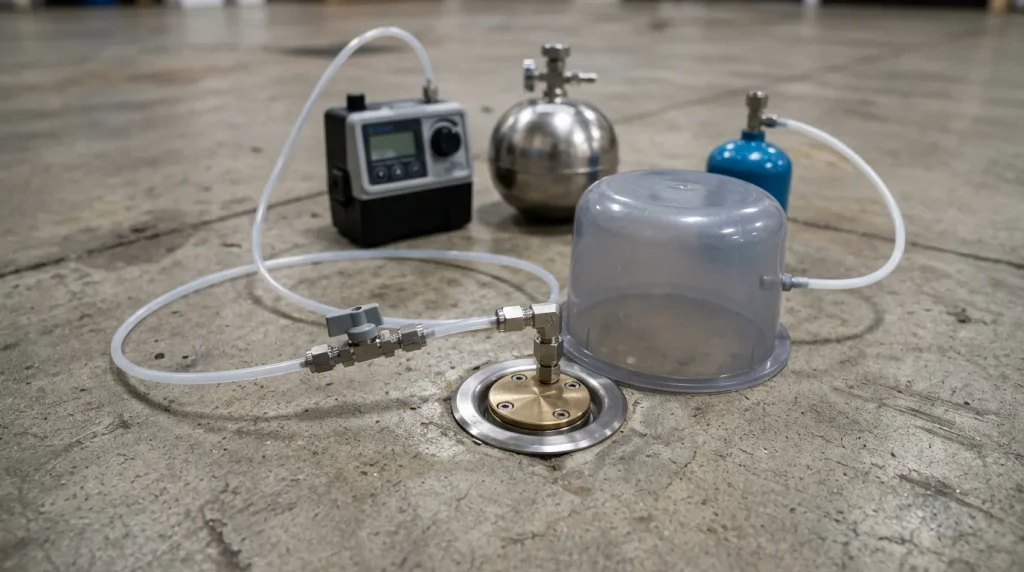
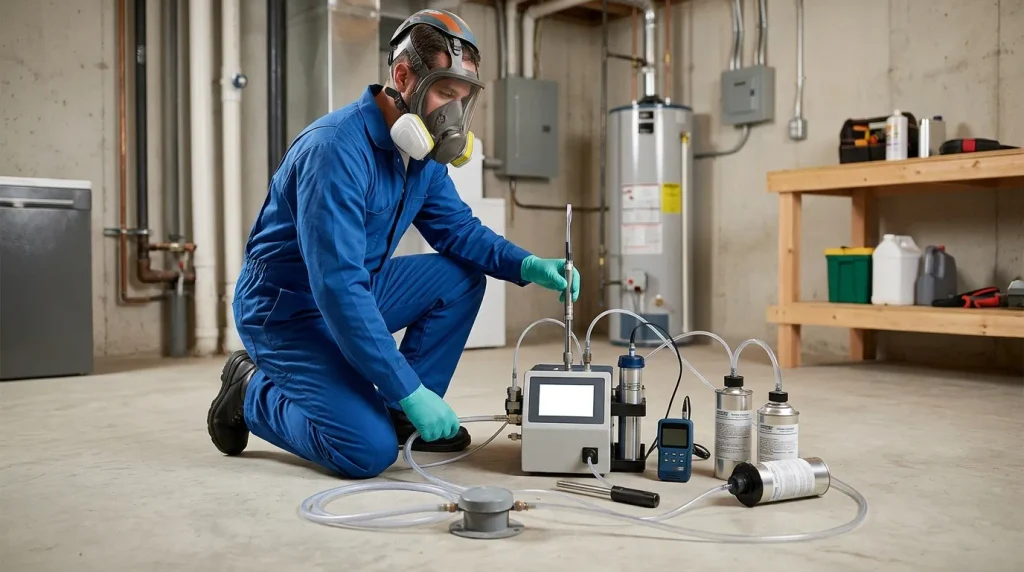
A small hole is cored through the concrete, typically under an inch across, and a permanent or temporary port is installed and sealed flush with the floor surface. The seal matters as much as the port, because a leaking seal pulls room air down into the sample and dilutes it.
Before any sample is taken, the probe is purged to remove stale air sitting in the void and the tubing. Then the integrity of the whole assembly gets verified. A common method is a tracer gas check, where helium is introduced around the port under a shroud and the sample stream is monitored. Helium showing up in the sample means the seal is leaking and the result would be meaningless. This step is easy to skip and it is one of the clearest signals of a careful sampling crew.
Collection itself uses an evacuated stainless steel canister fitted with a flow controller, or a sorbent tube drawing a measured volume. Sub-slab samples are often short, sometimes fifteen minutes or less, because soil gas concentrations are relatively stable compared with indoor air.
Small details carry real weight here. Tubing runs are kept short, usually around a meter, because a long line running through cold air lets condensation form and strip certain compounds out of the sample before it reaches the canister.
What indoor air sampling involves
Indoor air uses the same canister technology set to run much longer. The standard laboratory method for these compounds is a gas chromatography and mass spectrometry analysis of air collected in an evacuated canister, and it is not designed for sample durations beyond a few days.
Duration follows how the building is used. Roughly 8 hours is typical for a commercial or industrial space, matching a working shift. Roughly 24 hours is typical for residential or mixed-use, matching a full day of occupancy. Canisters are placed in the breathing zone, away from doors, vents, and windows, on the lowest occupied level first.
Where a single day of data is not considered representative, passive samplers can be deployed over weeks instead. They average out the day-to-day swings, at the cost of taking much longer to produce a result.
The building survey nobody expects
Before indoor sampling starts, someone walks the building and writes down what is in it. Solvents, degreasers, adhesives, paint, marker pens, stored fuel, recently dry-cleaned clothing, new furnishings, and cleaning products all contain the same compounds the laboratory will be looking for.
Items likely to interfere are removed or documented, and the building is often asked to hold off on certain activities during the sampling window. Occupants sometimes find this intrusive. It exists to prevent a false positive that would otherwise cost far more to disprove than the survey cost to perform.
This is also why the outdoor sample earns its place. If a compound appears indoors, outdoors, and not beneath the slab, the answer is probably not vapor intrusion.
How long does vapor intrusion testing take?
Three different clocks run, and people usually only ask about the first one.
| Stage | Typical duration |
| Field work | One day for port installation and sample collection, sometimes two for a larger building |
| Sample collection window | Minutes for sub-slab, 8 or 24 hours for indoor air, weeks for passive samplers |
| Laboratory analysis | Usually one to three weeks, depending on the laboratory and whether expedited turnaround was requested |
| Data evaluation and reporting | A further one to three weeks for the consultant to interpret results and produce a report |
| Multiple rounds | Months. Guidance recommends sampling across more than one season before conclusions are drawn |
That last row is the one that surprises people in a transaction. A single round rarely closes the question, and the seasonal spread is deliberate rather than padding. Our article on seasonal patterns explains why a winter result carries more weight than a summer one in Wisconsin.
What a sampling event looks like in an occupied building
Most buildings keep operating throughout. Here is the realistic version of the day.
- Access and coordination first. The crew needs to reach the lowest level, including any locked rooms, mechanical spaces, and tenant areas. This is usually the part that delays projects.
- Coring the slab. Brief, dusty, and noisy for a few minutes per location. Often scheduled outside business hours in retail or office settings.
- Ports set and left to settle. Sealant needs time to cure before sampling, so there is often a wait between installation and collection.
- Building survey and canister placement. Walking the space, recording products present, and setting canisters where they will not be disturbed.
- The sampling window. Normal operation continues, with a few requests: keep doors and windows in their usual position, avoid using solvents or painting, and do not move the canisters.
- Collection and demobilization. Canisters retrieved, final pressures recorded, ports sealed or left capped for future rounds.
Tenant communication is worth handling deliberately. Occupants who see unfamiliar equipment appear with no explanation tend to assume the worst, and a brief written notice beforehand prevents a great deal of avoidable concern.
What can go wrong with the data
Vapor sampling produces variable results for legitimate reasons, and knowing which reasons are normal helps when two rounds disagree.
- Seal leakage. Room air drawn into a sub-slab sample dilutes it and understates the concentration. This is what the tracer check exists to catch.
- Indoor background. Products inside the building producing a result that looks like intrusion.
- Weather during the window. Barometric pressure and precipitation in the days before sampling affect soil gas movement. Standard practice recommends reviewing hourly pressure and rainfall data for the three days beforehand when interpreting shallow or sub-slab results.
- Building operation. An exhaust fan running unusually, a door propped open, or HVAC in an atypical mode can shift results substantially.
- Short sampling duration. A single 8-hour window may not represent a long-term average, which is the figure risk assessments are built on.
- Condensation in the sample line. Long tubing in cold conditions can remove certain compounds before they reach the canister.
None of this is unique to chemical vapor. Radon measurement protocols exist for exactly the same reasons, which our explainer on understanding radon measurement and the effect of weather on radon testing both cover.
Who performs vapor intrusion testing in Wisconsin?
Investigation and regulatory reporting under ch. NR 700 is environmental consulting work. That covers the sampling work plan, the sample collection, interpretation against Wisconsin’s vapor action levels and vapor risk screening levels, submittals to the DNR, and case documentation.
Mitigation design and installation is contractor work, and for that half the DNR recommends contractors certified through the National Radon Proficiency Program. The department sets out both sides on its vapor intrusion resources page.
Wisconsin does not license radon or vapor contractors at the state level, so there is no state credential to verify. That places the burden on you to check certification directly and to ask for commercial project experience rather than residential work alone.
A practical note: if your building sits inside an open regulatory file, the sampling is likely being arranged by a responsible party or their consultant and the scope is set by the DNR. If it is not, and you are commissioning this yourself, an environmental consultant is the starting point rather than a mitigation contractor.
What happens after the results come back
The laboratory reports concentrations for each compound in each sample. Those get compared against Wisconsin’s screening values for the relevant building use, and the sub-slab and indoor air numbers get read against each other rather than in isolation.
Three broad outcomes follow. Everything below screening values, and the pathway is generally considered incomplete, though further rounds may still be requested. Elevated sub-slab with clean indoor air, and additional sampling usually follows, because the source is confirmed and only the entry is in question. Indoor air above screening values, and the conversation moves to mitigation, with the timeline compressing sharply if TCE is involved.
FAQ
Can I test for vapor intrusion myself with a DIY kit?
No. Unlike radon, there is no consumer test for chemical vapor intrusion. The compounds have to be identified individually by a laboratory, the screening values sit far below what any consumer device can detect, and a sub-slab sample requires drilling and sealing a port correctly before the result means anything. Consumer VOC monitors report a single combined reading that cannot be compared to a chemical-specific action level.
Do I have to allow access if a neighbor’s consultant asks to sample my building?
Access is normally requested rather than compelled, and property owners often do have the option to decline. Whether declining is wise is a separate question, since the request usually means someone believes contamination may extend beneath your property, and the sampling would be paid for by them rather than you. Access agreements also address liability, data sharing, and restoration. Have an environmental attorney review one before signing.
Will drilling sub-slab ports damage my floor or affect a warranty?
The cores are small, typically under an inch, and are patched flush with the surrounding surface. In finished spaces, port locations are usually chosen in utility areas or under removable flooring where possible. Where a slab is under warranty or carries a specialised coating, raise it before the work is scheduled rather than after, since location choices and patching materials can usually accommodate it if known in advance.
What happens to the sample ports after testing finishes?
It depends on whether more rounds are expected. Permanent ports are capped flush and left in place, which is the cheaper option where seasonal rounds are planned, since reinstalling costs more than leaving them. Temporary ports are removed and the core patched. Where a mitigation system is later installed, existing ports often become useful monitoring points.
Can I allow sub-slab sampling but refuse indoor air sampling?
You can ask, and it is sometimes agreed, but it weakens the result considerably. Sub-slab data on its own shows what is beneath the building, not what people are breathing, and the conclusion then rests entirely on a predicted relationship rather than a measurement. Where the concern is privacy or business disruption, those are usually solvable through timing and placement rather than by dropping the sample.
Conclusion
Understanding your vapor intrusion test results covers how those comparisons actually work, including what an attenuation factor is and why the sub-slab target is so much higher than the indoor air one.
If your results point toward mitigation, that is where Milwaukee Radon Mitigation comes in. We design and install vapor mitigation systems for commercial and industrial buildings across Milwaukee, Waukesha, and Ozaukee counties, and we work alongside your environmental consultant rather than replacing them. See our vapor intrusion mitigation services, request a free quote, or call (414) 455-7279.