
Cold weather usually does make vapor intrusion worse. In heating climates like Wisconsin, indoor concentrations tend to run higher in winter than in summer, and there are three good physical reasons for it.
The part most articles get wrong is treating that as a rule. It is a tendency. Research on seasonal patterns has found that the simple winter-worst model does not hold reliably across buildings, and how a building is sealed and operated can matter as much as the month on the calendar.
Both halves of that answer are worth understanding before you schedule a sampling event or try to explain why two rounds came back different.
Table of Contents
Does cold air make vapor intrusion worse?
Yes, through three separate mechanisms that all push the same direction in winter.
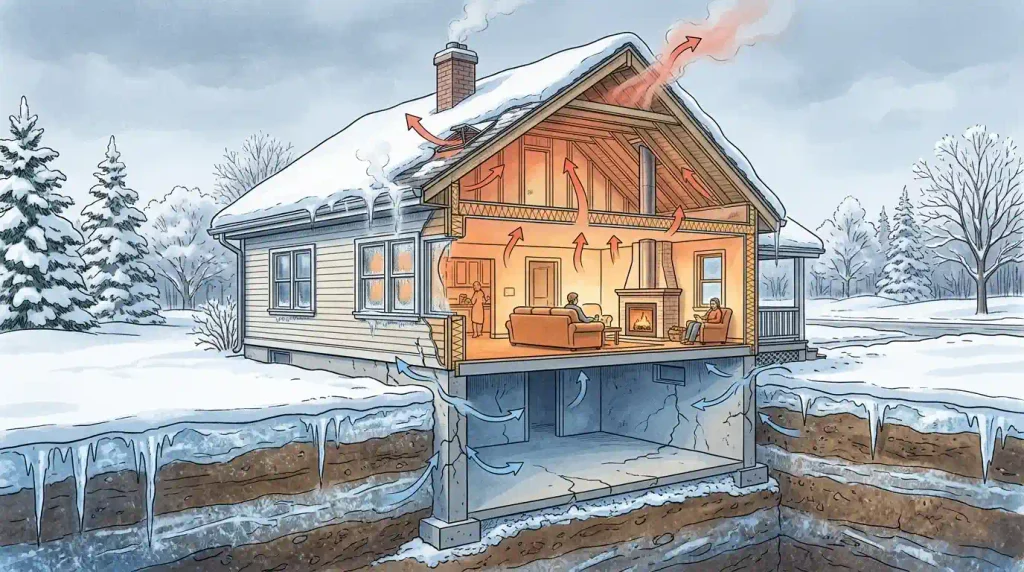
- The building pulls harder. A bigger gap between indoor and outdoor temperature strengthens the stack effect, which increases the vacuum at the lowest level.
- The ground seals over. Frozen soil and snow cover reduce how easily soil gas escapes upward through open ground, pushing more of it toward the nearest building.
- The building stops breathing. Windows stay shut for months, so whatever enters gets diluted far less than it would in May.
Those three combine into a real and repeatable effect. They are also why sampling plans in cold climates put weight on a winter round.
Why is vapor intrusion worse in winter
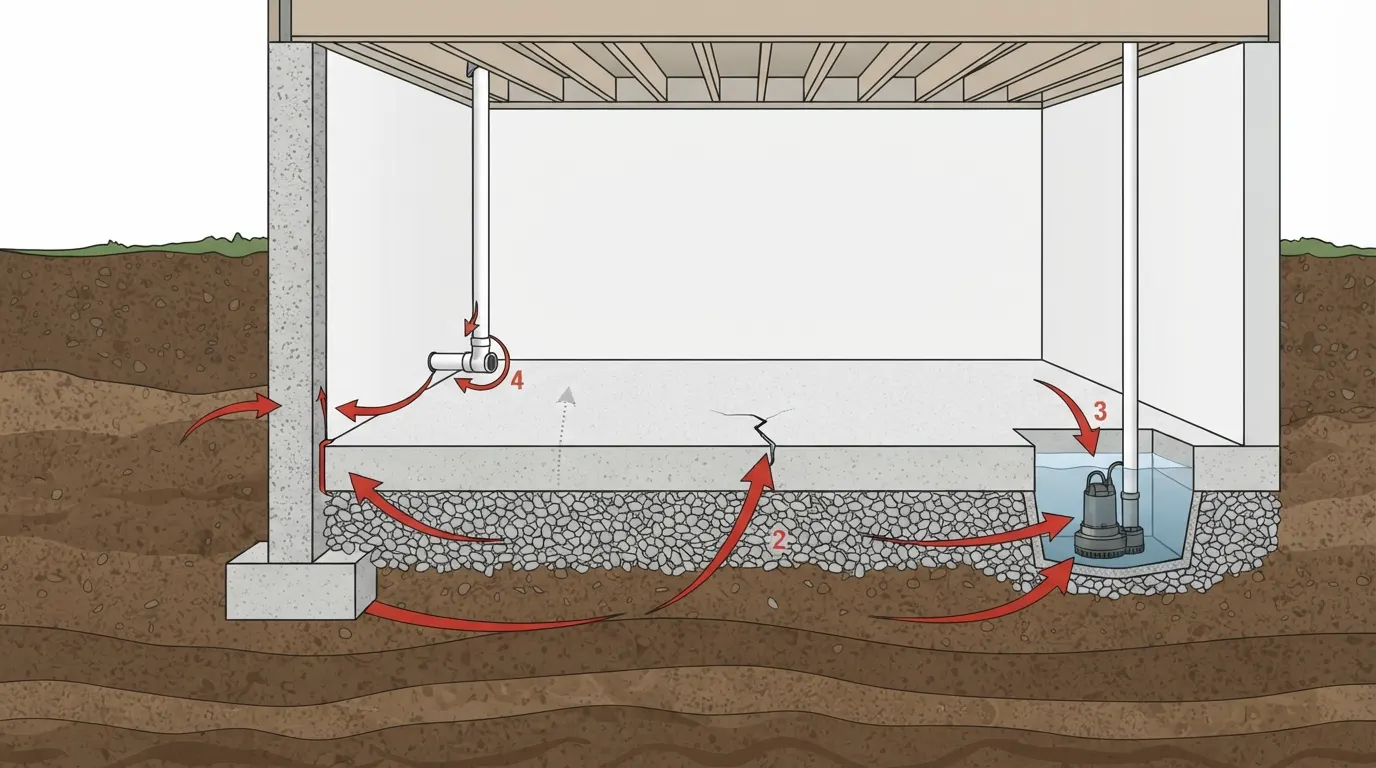
Warm air rises. In a heated building it escapes through upper floors, roof penetrations, and stairwells, and something has to replace it. Some of that replacement air gets drawn up through the foundation, bringing soil gas with it.
The strength of that draw scales with the temperature difference. A Milwaukee building held at 68 degrees on a 10 degree January day is working against a roughly 58 degree gap. The same building on a 70 degree day in June is working against nothing at all, and the stack effect largely disappears.
Wisconsin’s heating season runs roughly October through April, so this is not a brief window. It is more than half the year in which the physics favors soil gas entry.
Radon behaves identically, for the identical reason. Our article on the effect of weather on radon testing covers why closed-house conditions are written into radon test protocols, and why radon is heavier than air and how soil gas moves explains the pressure mechanics in more detail.
What frozen ground and snow cover actually do
Soil gas does not only move toward buildings. Under normal conditions a good deal of it vents harmlessly upward through open ground.
Frost changes that. Frozen soil and packed snow reduce the permeability of the surface, so the easy vertical escape route closes. The gas still has to go somewhere, and the path of least resistance becomes whatever is warm, unfrozen, and slightly depressurized nearby. That is the building.
Rain and snowmelt do something similar on a shorter timescale by filling soil pore spaces with water. Saturated ground blocks vapor movement upward and pushes it sideways, which is why levels can spike after a heavy melt even when the temperature has risen.
This is the same mechanism behind rainfall raising indoor radon levels, and it is one of the more consistent short-term effects in both fields.
Barometric pressure and short-term swings
Season sets the baseline. Weather moves the number day to day.
A falling barometer reduces atmospheric pressure at the ground surface faster than it reduces pressure in the soil below, which briefly increases the flow of soil gas toward the surface and into buildings. Rising humidity has been associated with the same effect. Wind can either help or hurt depending on direction and building geometry.
The practical consequence is that two samples collected in the same week, in the same building, can differ meaningfully. This is not sloppy work. It is the pathway behaving normally.
Why winter-worst is not a rule you can build a plan on
Here is where most coverage of this topic goes wrong.
A critical review of climate and weather driven variability in vapor intrusion concluded that a simple stack-effect-based winter-worst model is inadequate for predicting when concentrations peak. Building-specific factors, including how thoroughly the building is weatherized and how occupants actually operate it seasonally, need to be understood before anyone can say when the worst-case window falls for a particular property.
Some concrete reasons a Wisconsin building might not peak in winter:
- A mechanically ventilated commercial building may run at neutral or positive pressure in heating season, which suppresses the stack effect entirely
- A building with a leaky envelope dilutes incoming vapor with outside air even in January
- A warehouse with frequent dock door openings behaves nothing like a sealed office
- Summer air conditioning in a tightly sealed building can produce its own closed-house conditions
- Basement dehumidifiers, exhaust fans, and make-up air units shift building pressure independently of the weather
There is a broader variability problem underneath all of this. An EPA analysis of hundreds of buildings across dozens of sites found that attenuation factors, the relationship between what is under the slab and what reaches indoor air, vary by a factor of ten to a thousand within individual sites. Against that much natural spread, season is one input among several rather than the deciding one.
Why the answer is different in warmer climates
If you search this question you will find pages arguing that vapor intrusion peaks in summer. They are not wrong, they are describing a different climate.
In warm regions, buildings are sealed and air conditioned through the hot months and opened up in mild weather. The closed-house condition that drives concentrations up lands in July rather than January. Studies have documented peak indoor concentrations in summer for exactly this reason.
So the honest general rule is that concentrations peak when the building is most closed and most depressurized, not when it is coldest. In Wisconsin those two things coincide in winter. In milder places they do not.
What this means for sampling in Wisconsin
EPA guidance recommends multiple rounds of sampling across multiple seasons rather than a single snapshot, precisely because of the variability described above. A few practical implications follow from that.
| Situation | What it usually means |
| Clean result from a winter round | Carries more weight than a clean summer result, since it was collected closer to reasonable worst-case conditions |
| Clean result from a summer round only | Less conclusive. A follow-up heating-season round is often requested before the pathway is considered closed |
| Two rounds that disagree | Normal rather than alarming. Interpretation looks at building conditions during each event, not just the numbers |
| Elevated sub-slab, clean indoor air | Usually triggers additional rounds, because the source is confirmed and only the entry is in question |
| TCE present at any level | Season becomes secondary. Wisconsin guidance calls for expedited action rather than waiting for an ideal sampling window |
FAQ
Is a summer sampling result meaningless in Wisconsin?
No, but it is weaker evidence on its own. A clean summer result shows the pathway was not delivering vapor under favorable conditions. It does not show what happens in February.
Where a summer round is the only data available, a heating-season round is commonly requested before the pathway is considered closed. Where the summer result is elevated, that is a strong finding, since conditions were working against detection.
Does a cold snap raise levels the same day, or does it take time?
Both effects exist on different timescales. The stack effect responds within hours, so a sharp temperature drop can raise indoor concentrations the same day.
Ground freezing is slower and builds over weeks as frost depth increases. That is part of why late winter readings sometimes exceed early winter readings even when the air temperature is similar.
Do vacant or partly heated buildings behave differently in winter?
Yes, and this catches people out during redevelopment. A building held at 50 degrees has a much weaker stack effect than one held at 70, so a vacant property can sample low and then produce very different numbers once it is occupied and fully heated.
Sampling a vacant building tells you about the vacant building. If occupancy is planned, the sampling plan should account for how it will actually be operated.
Does snow on the roof matter, or only snow on the ground?
Ground snow is what matters for the pathway, because it reduces surface permeability and limits where soil gas can vent.
Roof snow does not affect soil gas movement. It can slightly affect building ventilation by covering roof vents, but that is a minor factor compared to what is happening at ground level.
Does radon follow the same seasonal pattern?
Very closely, since both are soil gases moving through the same pathway under the same pressure conditions.
This is one reason radon is sometimes measured alongside vapor sampling as a tracer, to help confirm whether a soil gas pathway into the building is open. The health benchmarks and the regulatory frameworks are completely different, but the physics is shared.
Conclusion
It works against more, which is not quite the same thing.
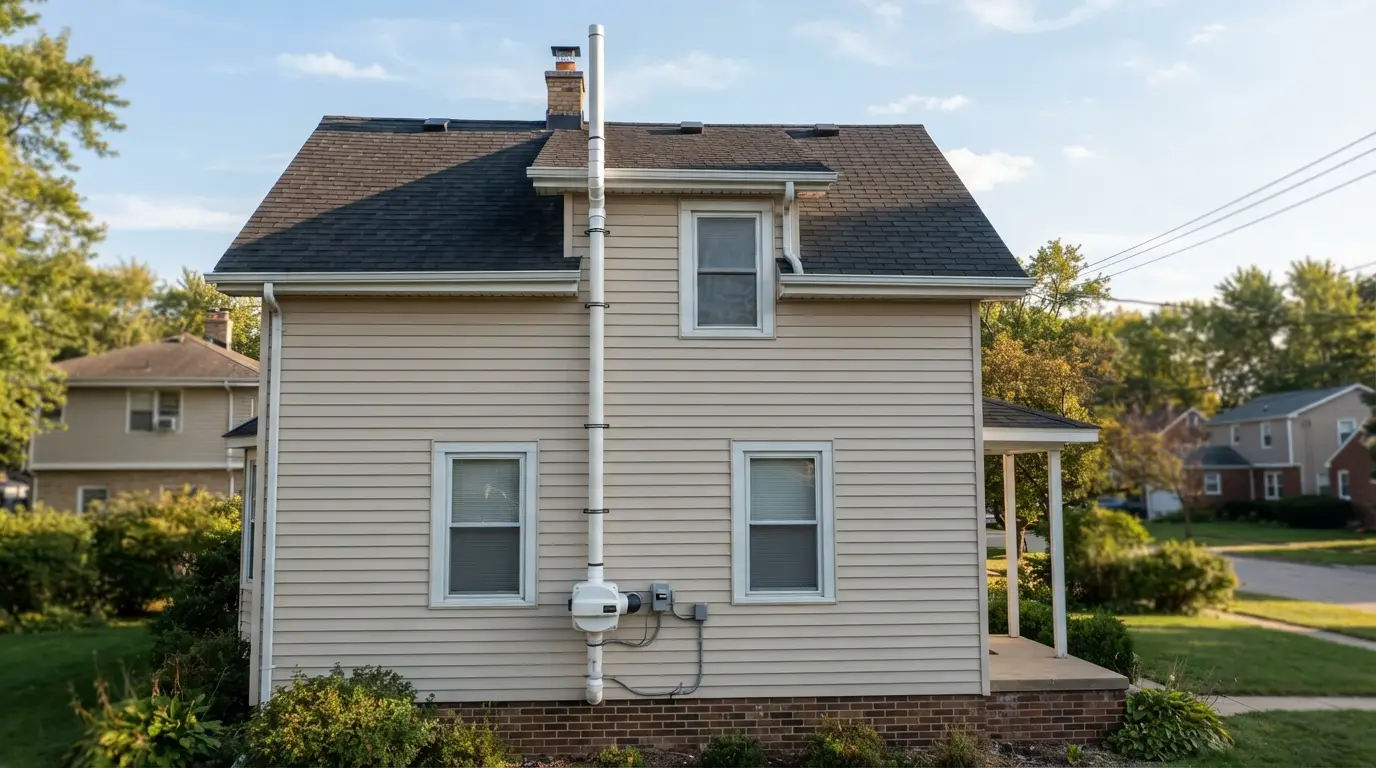
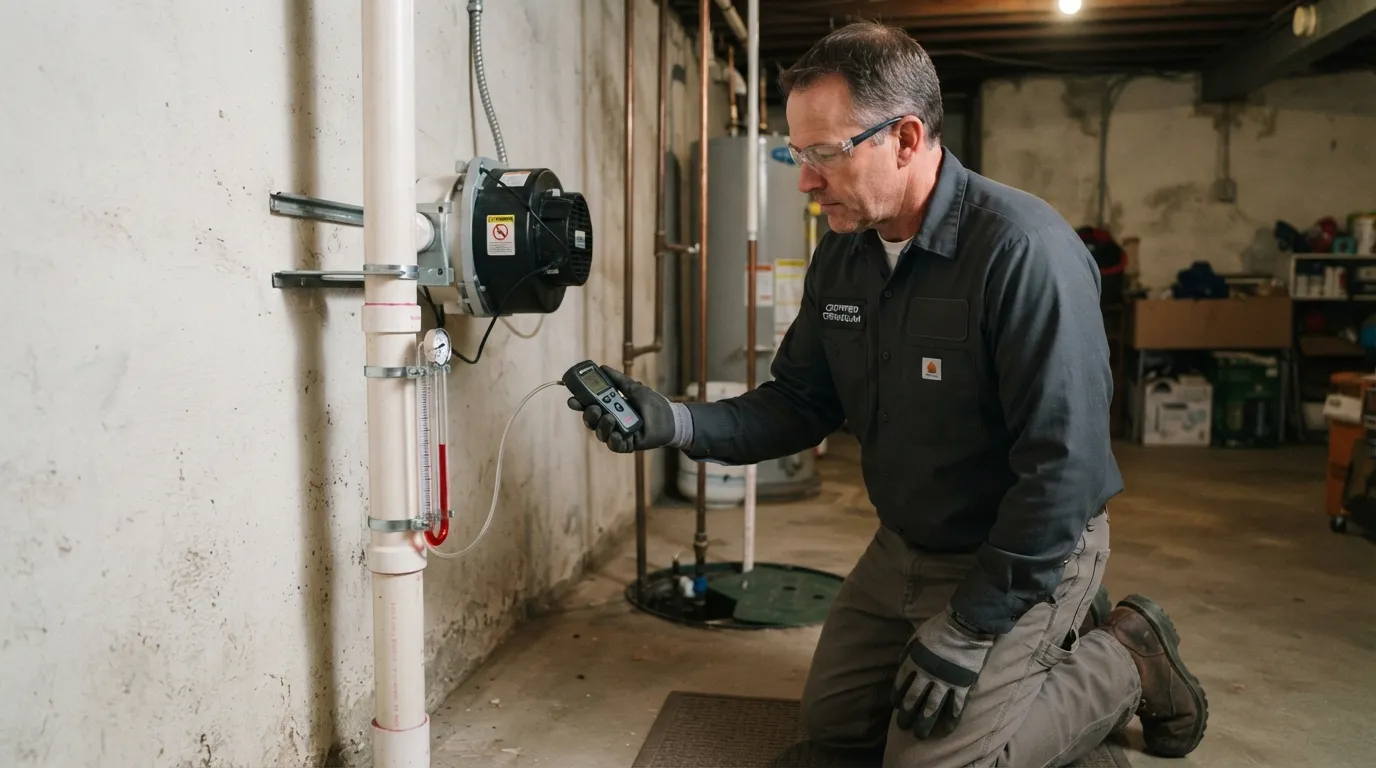
An active sub-slab system holds a vacuum under the floor regardless of season. In winter it is competing with a stronger stack effect, so the pressure field it has to overcome is larger. A system designed with adequate margin handles that without any change in performance. A system that was marginal to begin with can fall short in January while testing fine in July.
This is one of the practical arguments for pressure monitoring and alarms rather than an annual visual check. A system can lose performance in the exact conditions when the building needs it most, and nothing about that is visible from across the room.
The same logic drives annual system inspections on the radon side, where a fan that failed quietly in November is not discovered until spring.
Milwaukee Radon Mitigation designs and installs vapor intrusion mitigation systems for commercial and industrial properties across Milwaukee, Waukesha, and Ozaukee counties, and sizes them for Wisconsin heating-season conditions rather than mild-weather averages. See our vapor intrusion mitigation services, request a free quote, or call (414) 455-7279.