
Vapor barriers vs sub-slab depressurization: what a vapor intrusion barrier does, what it cannot do, and which one actually stops chemical vapors. For a building with a confirmed chemical vapor problem, the pressure control does the work and the barrier supports it.
Where that gets interesting is that the two solve genuinely different physics problems, and a barrier specified for the wrong contaminant can look compliant on paper while doing very little.
Table of Contents
Two different physics problems
Soil vapor reaches a building two ways, and they are not equally important.
Diffusion is slow spreading from higher concentration to lower. It happens through open pore space and also straight through solid materials, including concrete and plastic sheeting. It is constant, gentle, and relatively small.
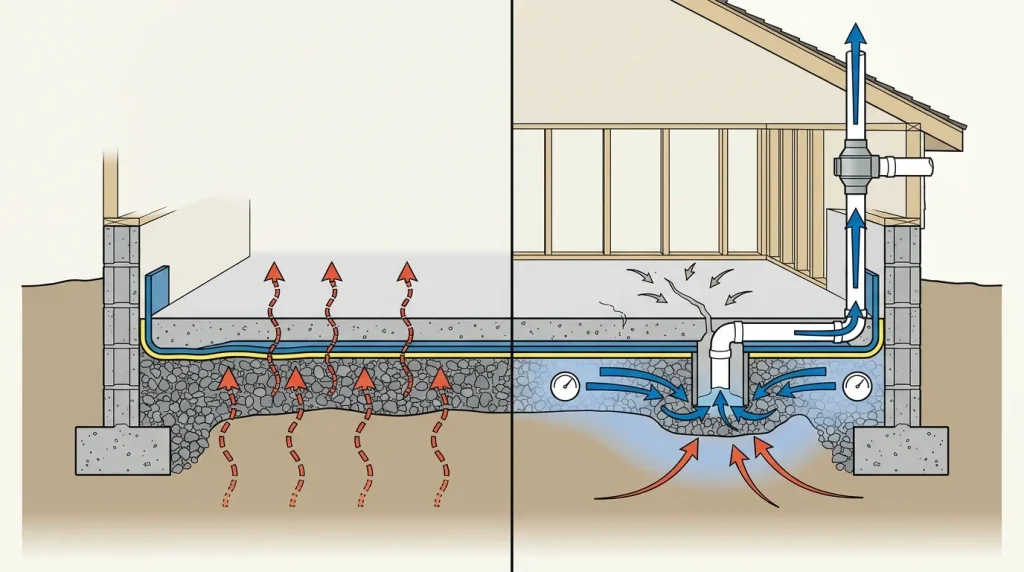
Advection is bulk flow driven by a pressure difference. A heated building sits at slightly lower pressure than the soil beneath it and physically draws soil gas through every crack and penetration. In most buildings this moves far more vapor than diffusion does.
A barrier is a diffusion control. Depressurization is an advection control. If the dominant mechanism in your building is the building pulling, then a barrier is addressing the smaller half of the problem.
Our article on what causes vapor intrusion covers both mechanisms in more detail, including why building size and season change the balance between them.
Vapor Barriers vs Sub-Slab Depressurization
| Vapor intrusion barrier | Sub-slab depressurization | |
| What it addresses | Diffusion, the slow spread of vapor through materials | Advection, bulk flow driven by pressure difference |
| How it works | Puts a low-permeability layer between soil and building | Reverses the pressure difference so vapor moves outward |
| Active or passive | Passive, no moving parts | Active, fan-driven and continuously running |
| Can it be verified after install? | Not once concrete is poured over it | Yes, vacuum field measurement at any time |
| Does it signal failure? | No | Yes, with pressure monitoring or telemetry |
| Adjustable later | No | Yes, fan and suction points can be changed |
| Best fit | New construction, as one layer of a system | Existing buildings and any confirmed chemical vapor problem |
| Ongoing cost | None after installation | Electricity, monitoring, and inspection |
What a vapor intrusion barrier actually does
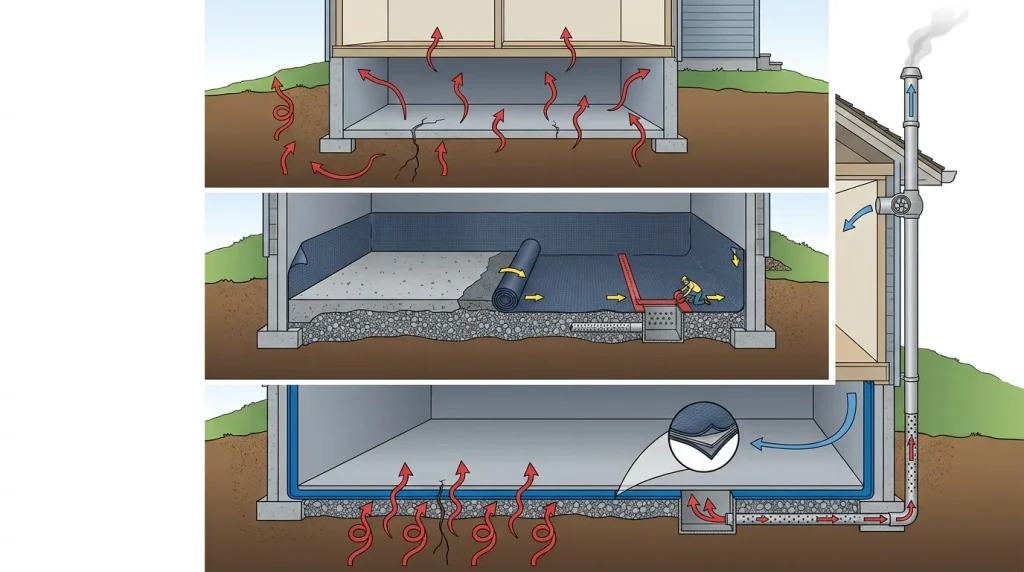
A barrier is a continuous low-permeability layer placed between the soil and the building, usually under the slab and often carried up foundation walls. It comes as sheet geomembrane or as a spray-applied membrane that cures in place, and it is normally installed during construction.
Its performance depends on three things, in descending order of how often they go wrong:
- Continuity. Seams, penetrations, corners, and terminations are where barriers fail. A membrane with excellent laboratory numbers and a badly detailed pipe penetration performs like a membrane with a hole in it.
- Material suitability. Different polymers resist different chemicals very differently. This is the part most specifications get wrong.
- Protection during construction. Rebar, foot traffic, and equipment damage membranes before the pour, and the damage is invisible afterward.
Not every barrier resists chemical vapor
Here is the technical point that changes specifications, and it is the reason this article exists.
Polyethylene sheeting is the default underslab membrane and it is acceptable for radon. Chlorinated solvents are a different matter. Compounds such as TCE and PCE diffuse through polyethylene at rates that make thin poly sheeting a weak barrier against them, even when it is intact and correctly installed.
Membranes built for chemical vapor address this with a different material in the middle. Composite geomembranes with an ethylene vinyl alcohol core, usually written EVOH, show diffusion coefficients for TCE several orders of magnitude lower than polyethylene of comparable thickness. Research presented to the radon industry has put that gap at roughly four orders of magnitude for TCE. Spray-applied asphalt latex systems, often combined with a geomembrane, are the other common approach.
A related trap sits in the specifications themselves. The widely cited underslab vapor retarder standard is a moisture performance standard. A membrane that meets its Class A requirements has demonstrated resistance to water vapor transmission. That says nothing about how it performs against benzene or TCE. A barrier described as meeting that standard is making a moisture claim, and on a contaminated site it needs chemical-specific data instead.
The question to ask a supplier or installer: what is the diffusion or permeation data for this membrane against the specific compounds identified on my site? If the answer is a moisture rating or a thickness in mils, that is not an answer to the question.
What sub-slab depressurization does
A fan pulls a slight vacuum on the space beneath the slab through one or more suction points. Soil gas moves into the piping and discharges above the roofline instead of into the building.
That reverses the pressure difference rather than resisting it, which produces three practical advantages a barrier cannot match. The vacuum field can be measured after installation, so coverage is demonstrable rather than assumed. Performance can be monitored continuously and alarmed when it drops. And the system can be modified later by adding suction points or changing the fan if conditions change or the first design falls short.
The cost is that it never stops. It draws power, it needs inspection, and a failed fan protects nobody. That is why monitoring matters more on a vapor system than on a residential radon install.
The mechanics are the same ones behind residential work, covered in how radon mitigation systems work in Milwaukee.
Which one controls soil vapor?
For a building with confirmed chemical vapor above screening levels, depressurization. Every time.
The reasoning is straightforward. Depressurization addresses the dominant transport mechanism, it can be verified, and it can be fixed if it underperforms. A barrier addresses the secondary mechanism, cannot be inspected once buried, and offers no way to know it has failed.
Regulators reflect this. Wisconsin’s guidance points toward active systems with notification and monitoring, and the industry design standards are built around active soil gas control with barriers as a component rather than a substitute.
There is one honest caveat. In new construction where contamination is known but concentrations are modest, a well-specified barrier paired with a passive vent system, designed so a fan can be added later, is a legitimate approach that some sites use successfully. It is a design decision made on data, not a way to avoid installing a system.
Why a barrier alone is rarely enough
Setting material performance aside entirely, four structural problems remain:
- It cannot be inspected after the pour. Whatever condition the membrane was in when the concrete covered it is the condition it stays in, and nobody can check.
- It gives no failure signal. A torn membrane and a perfect one look identical from inside the building.
- Penetrations accumulate. Every pipe, conduit, and post added over the building’s life is a new opportunity for a breach, and retrofit trades rarely know a vapor barrier is down there.
- It does nothing about the pressure difference. The building keeps pulling, and any imperfection becomes a preferred route.
None of this makes barriers useless. It makes them a layer rather than a solution.
Where barriers genuinely earn their place
Four situations where a barrier is worth specifying properly rather than treating as optional:
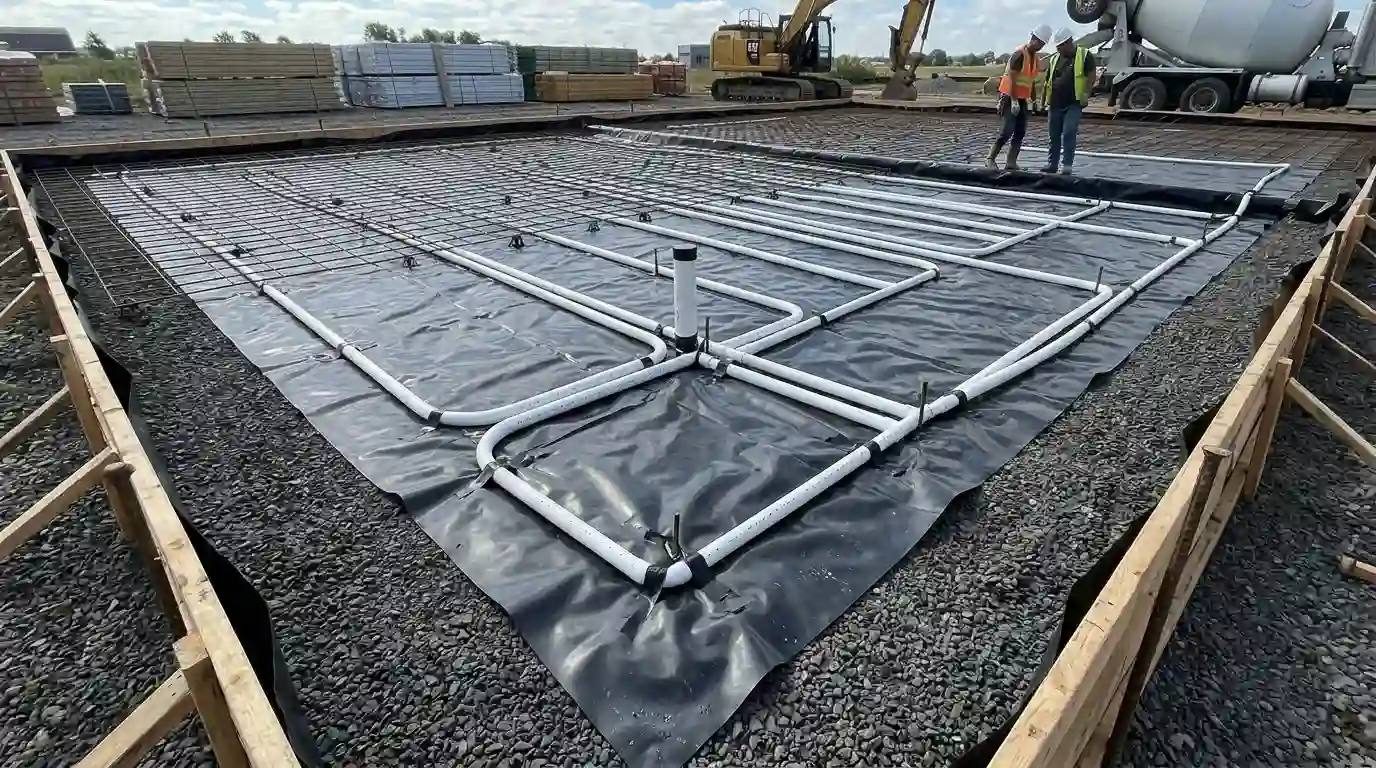
- New construction on a known site. Membrane and vent piping installed during the build cost a fraction of retrofitting an occupied building, and the detailing can actually be done well because the trades have access.
- Very high sub-slab concentrations. A barrier reduces the load the active system has to handle, which can mean a smaller fan and lower operating cost over the building’s life.
- Earthen crawl spaces and dirt floors. With no slab at all, a sealed liner is the surface the depressurization system pulls against. Here the barrier is not optional, it is part of the mechanism.
- Redundancy on higher-risk buildings. Where the contaminant carries acute risk, a second layer that keeps working during a fan outage has real value.
The new construction case is the strongest, and it is the same argument behind radon-resistant construction in Wisconsin, where soil gas control is designed into the slab rather than added later. MRH’s new construction service covers that work.
What about radon barriers?
Different question, and a much simpler one. Radon does not attack membrane materials and does not diffuse through polyethylene the way chlorinated solvents do, so the material requirements are considerably less demanding and standard sheeting is acceptable in most residential applications.
The pressure logic still holds, though. A barrier alone rarely brings radon levels down on its own, because the building is still pulling. In a crawl space the liner and the fan work together, and neither does the job by itself.
If radon rather than chemical vapor is what you are dealing with, the types of radon mitigation system is the better starting point, and our comparison of vapor intrusion and radon covers why the two problems need different treatment despite sharing a pathway.
FAQ
Does a thicker barrier perform better against chemical vapor?
Thickness helps, but material matters far more. Doubling the thickness of a polyethylene sheet roughly halves the diffusion rate through it. Switching to a membrane with a chemically resistant core can reduce it by orders of magnitude. A thick sheet of the wrong polymer is still the wrong polymer, and thickness does nothing at all for the seams and penetrations where most failures actually occur.
Can a barrier be added to a building that already exists?
Not under an existing slab, which is the location that matters most. Options for existing buildings are limited to coatings applied to the top of the slab, membranes in crawl spaces, and sealing at joints and penetrations. Surface coatings have a mixed record because concrete cracks and moves. This asymmetry is a large part of why active depressurization is the standard answer for existing buildings.
Does the concrete slab itself count as a barrier?
Partially, and less than people assume. Concrete is porous and vapor diffuses through it, and every slab develops shrinkage cracks as it cures. A thick, well-cured, crack-free slab does slow vapor movement. It is treated as a contributing factor in the analysis rather than as a control measure.
What happens at pipe penetrations and seams?
They are detailed with compatible tapes, boots, and sealants specified by the membrane manufacturer, and this is where installation quality shows. A penetration sealed with an incompatible product can degrade over time, particularly around solvents. On chemical vapor sites the detailing products need the same chemical compatibility scrutiny as the membrane itself, which is a step that gets skipped surprisingly often.
Can a passive barrier and vent system be upgraded to active later?
Yes, if it was designed for it. A passive system with correctly sized piping, an accessible riser, and a planned fan location converts readily. A passive system installed without that forethought can require substantial rework. If passive is the chosen approach, the conversion path should be in the design documents from day one, not assumed.
Conclusion
The decision comes from data, not from preference. What compounds are present, at what sub-slab concentrations, under what building conditions, and whether the building exists yet.
An occupied building with confirmed solvent vapor needs an active system, and the barrier question becomes whether to add one for load reduction. A building still on paper has the more interesting choice, because both options are cheap at that stage and designing for both costs far less than either retrofit would.
Milwaukee Radon Mitigation designs soil gas control for commercial and industrial buildings across Milwaukee, Waukesha, and Ozaukee counties, including systems built into new construction. See our vapor intrusion mitigation services, request a free quote, or call (414) 455-7279.