
Vapor intrusion is caused by three things happening at once: a chemical source in the soil or groundwater, a pathway for those vapors to travel, and a building that pulls them inside. Remove any one of the three and the problem stops. That is why two buildings sitting on the same contaminated block can get completely different test results.
Most property owners ask what causes vapor intrusion only after a consultant letter arrives, or after a Phase I assessment flags a neighbor’s old file. Suddenly the question is how vapors from something that happened decades ago ended up in a building nobody has spilled anything in. Here is the mechanism, one piece at a time.
Table of Contents
What causes vapor intrusion: the three conditions that must line up
Environmental professionals call this the source-pathway-receptor model. All three links have to be intact for exposure to occur.
- A source. Volatile chemicals sitting in soil, dissolved in groundwater, or pooled as free product. Without contamination there is nothing to intrude.
- A pathway. Connected air space in the soil, or a human-made channel like a sewer line, that lets vapor move from the source toward the building.
- A driving force. A pressure or concentration difference that actually moves the vapor and gives it a way through the foundation.
Investigations work down this chain in order. That is also why a building can sit directly above a plume and still test clean. If the slab is intact, the building runs at neutral pressure, and nothing connects the plume to the foundation, the pathway is broken.
Where the contamination comes from
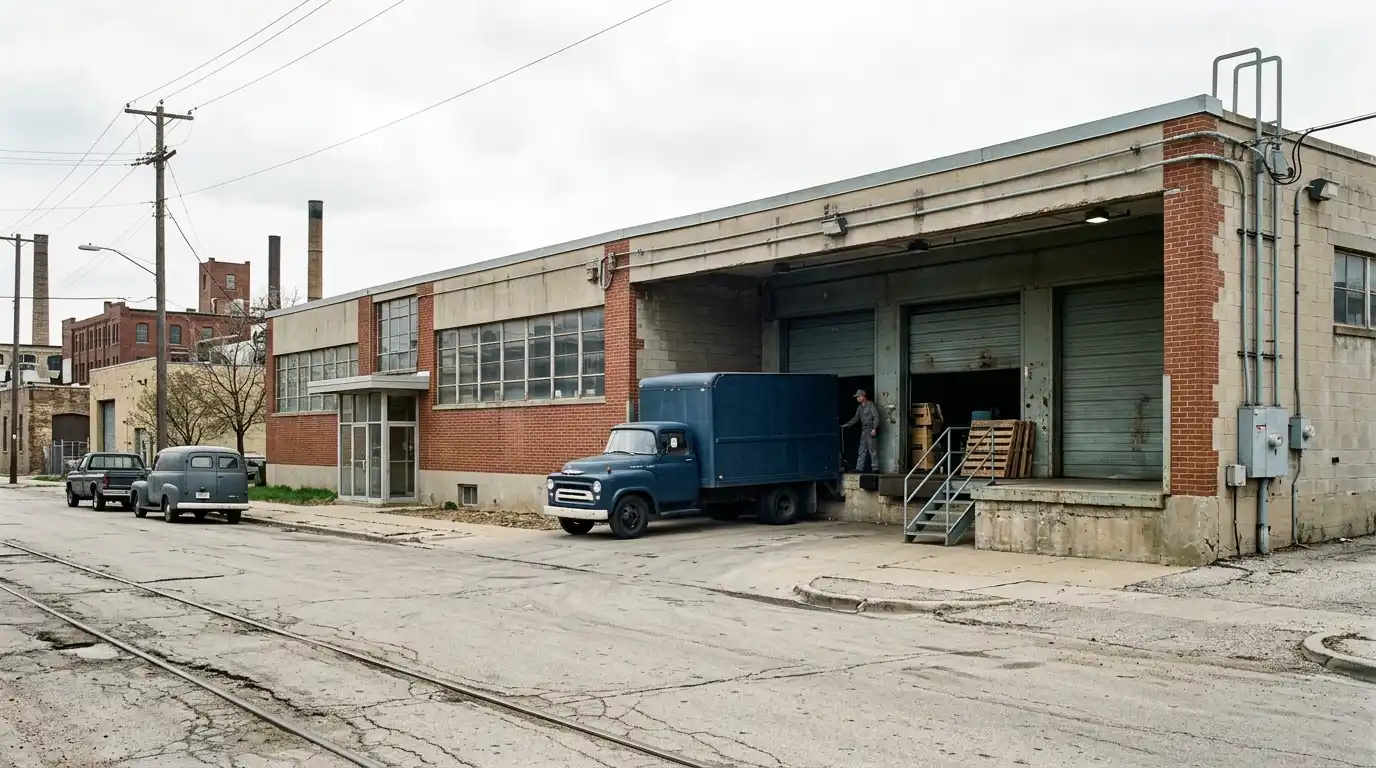
The sources are almost always industrial or commercial history, and southeastern Wisconsin has a lot of it. Milwaukee County carries a dense layer of former manufacturing, metal finishing, printing, and fuel storage, plus decades of small dry cleaners in neighborhood retail strips.
The usual suspects:
- Dry cleaners. Tetrachloroethylene, usually written PCE, released through floor drains, spills, and old separator units. Wisconsin runs a dedicated response fund for dry cleaner contamination, which tells you how common these releases are.
- Metal fabrication and degreasing. Trichloroethylene, or TCE, was the standard degreasing solvent for decades across machine shops and plating operations.
- Leaking underground storage tanks. Gas stations, fleet yards, and buildings with old heating oil tanks. Benzene is the compound of concern here.
- Closed landfills and imported fill. Methane and other landfill gases, often under parcels redeveloped long after the fill went in.
- Manufacturing floor drains. Older facilities routinely discharged solvent-bearing wash water straight to soil.
The release usually predates the current owner by decades. Solvent handling that was ordinary practice in 1965 created plumes that are still moving today. Wisconsin’s dry cleaner contamination program exists specifically because those small-site releases turned out to be widespread.
Does the source have to be on my property?
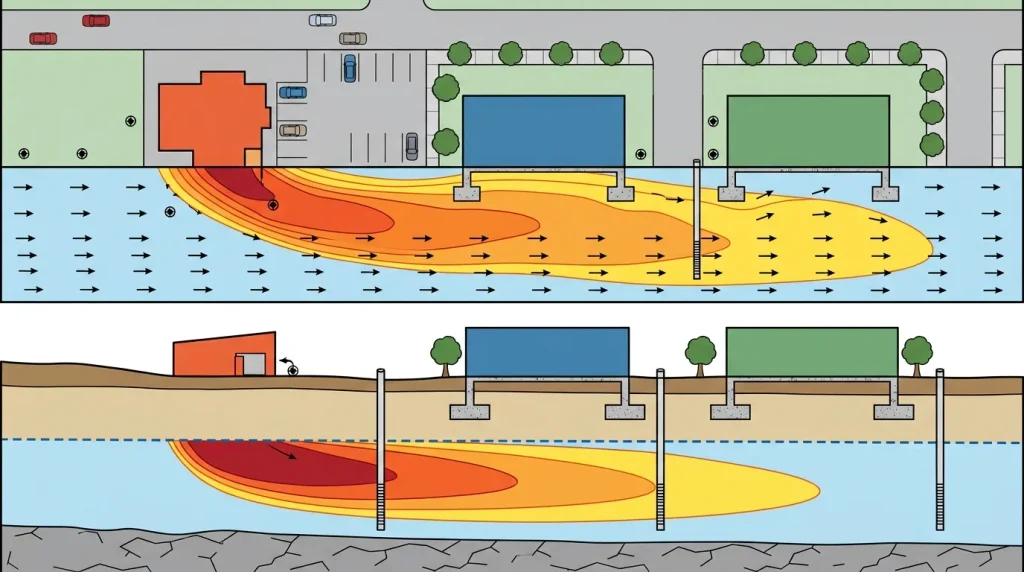
No, and this is the single most common surprise. Contaminated groundwater moves. A release two blocks upgradient can send a plume under a building that has never stored a drum of anything.
Screening standards account for this with distance-based search radiuses. Under ASTM E2600, the vapor encroachment screen looks roughly a third of a mile out for non-petroleum releases and a tenth of a mile for petroleum ones. Those distances exist because vapor risk does not respect parcel lines.
The practical version: if you receive a letter asking permission to sample your building, it does not mean your property is contaminated. It usually means someone else’s plume may extend under it, and they are legally obligated to find out.
Why petroleum and solvent releases behave differently
This distinction decides how seriously a given release gets treated, and most general articles skip it entirely.
Petroleum compounds biodegrade. Naturally occurring bacteria in the unsaturated soil above the water table consume them in the presence of oxygen, often breaking them down before they ever reach a foundation. EPA treats this as substantial enough to screen many petroleum sites out on physical separation alone. The agency’s petroleum guidance points to a vertical separation of about 6 feet between a building and a dissolved source, or about 15 feet where free product is present beneath a building up to 66 feet on its shortest side, as generally adequate to rule out the pathway.
Chlorinated solvents do not get that help. TCE and PCE break down slowly and only under oxygen-poor conditions, and some of the intermediate breakdown products are more toxic than the parent compound. There is no depth at which a solvent release can simply be screened out.
So a diesel or gasoline release can absolutely cause vapor intrusion, but it needs closer proximity to do it. A solvent release of the same age and size is the more serious vapor problem almost every time.
| Petroleum (benzene, diesel, gasoline) | Chlorinated solvents (TCE, PCE) | |
| Breaks down in soil | Yes, aerobically and often quickly | Slowly, and only without oxygen |
| Can be screened out by distance | Often yes, using separation distances | No, depth alone does not rule it out |
| Breakdown products | Generally harmless end products | Can be more toxic than the original compound |
| Typical source | Underground storage tanks, fuel handling | Dry cleaners, degreasing, metal finishing |
| Governing EPA guidance | Petroleum vapor intrusion guide for UST sites | The 2015 OSWER technical guide |
One wrinkle that matters for commercial buildings specifically. Aerobic breakdown needs oxygen reaching the soil beneath the slab, and a large building footprint blocks that resupply from above. EPA calls the resulting low-oxygen area an oxygen shadow, and it means a big warehouse can lose some of the natural protection a small building would get from the same release. Building size is a risk factor, not a neutral detail. EPA’s petroleum vapor intrusion resources cover the modeling behind this.
How vapors travel through the soil
Two mechanisms move vapor, and they work on different scales.
Diffusion is slow spreading from higher concentration toward lower concentration. It happens constantly, in every direction, through the air spaces between soil particles.
Advection is bulk flow driven by a pressure difference. It is faster and more directional, and it is what actually carries vapor the last stretch into a building.
Soil conditions decide how well either works. Coarse sand and gravel let vapor move freely. Dense clay slows it down. Saturated soil blocks it almost entirely, which is why heavy rain and snowmelt can temporarily cap the ground and push soil gas sideways toward the nearest building instead of letting it vent upward.
Radon behaves the same way in the same soil, which is why rainfall raises indoor radon levels and why soil conditions drive high radon concentrations in certain homes. The physics of soil gas movement does not care what the gas is.
Wisconsin also treats human-made channels as a separate pathway. Sanitary sewers and utility trenches can carry vapor long distances laterally and deliver it into a building nowhere near the plume. The DNR publishes standalone guidance on documenting these preferential pathways, including a sewer gas screening level, because a building can test clean at the slab and still have a sewer-borne problem.
What building conditions make vapor intrusion worse?
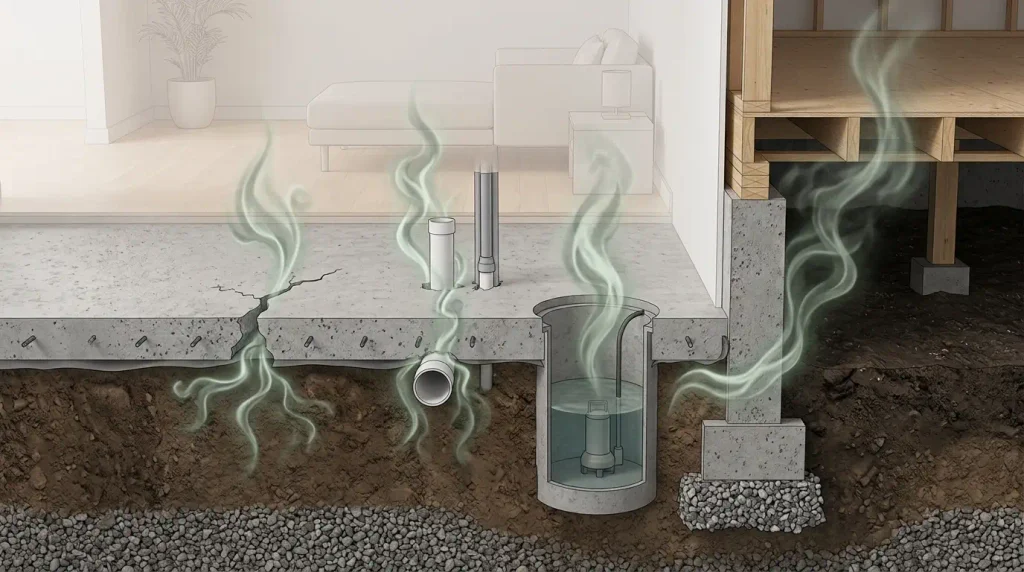
The building is not a passive victim here. It actively pulls soil gas in.
Warm indoor air rises and escapes through upper floors and the roof. Air has to come from somewhere to replace it, and some of it gets drawn up through the foundation. This stack effect is strongest in winter, when the indoor and outdoor temperature gap is widest, which is why Wisconsin sampling plans pay attention to the season.
Conditions that increase the pull:
- Exhaust fans, kitchen hoods, and dryers running without matching make-up air, which puts the whole lower level under negative pressure
- HVAC systems that are unbalanced or return air from the lowest level
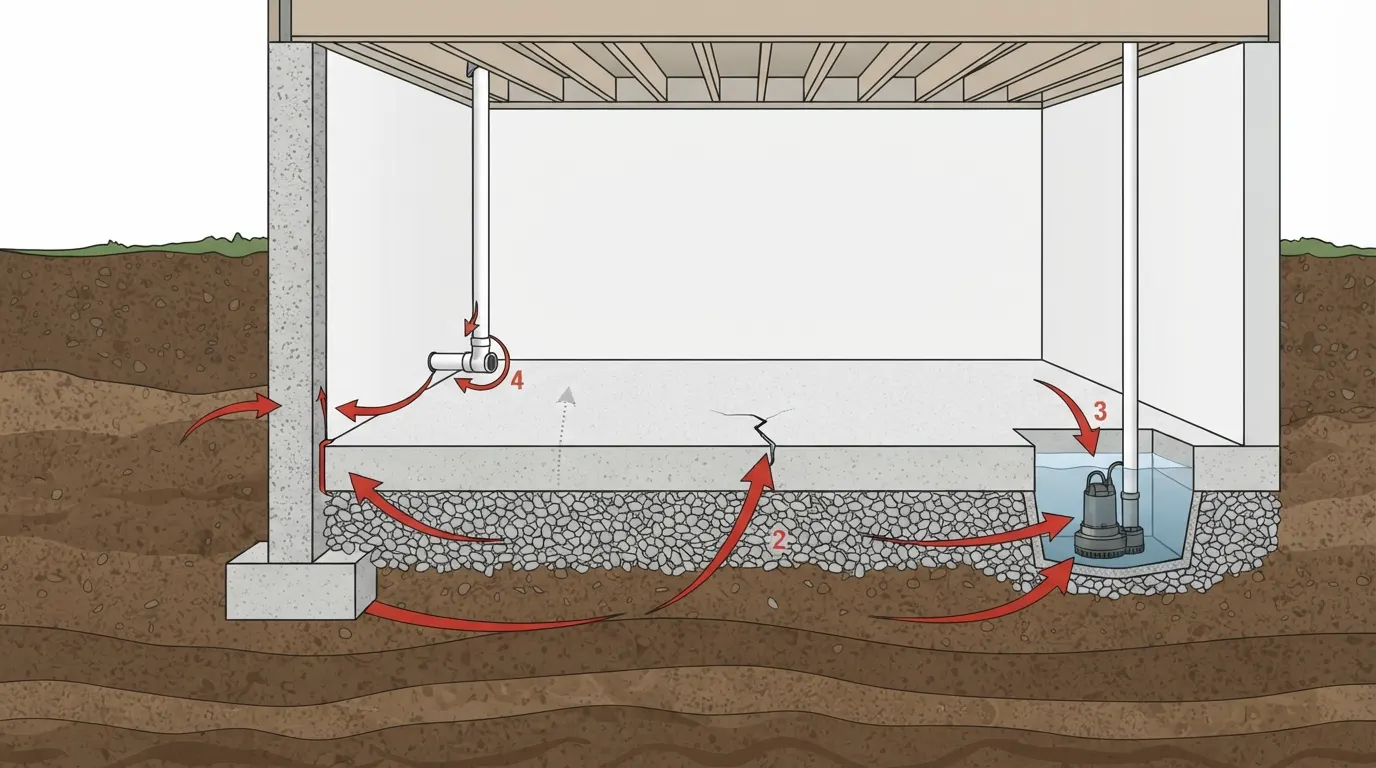
- Cracks, cold joints, and unsealed utility penetrations in the slab or foundation wall
- Sumps, floor drains, elevator pits, and earthen crawl spaces
- Older foundations with block walls, which are far more permeable than poured concrete
- Large slab area, which increases both the contact surface and the oxygen shadow discussed earlier
Anyone who has dealt with radon will recognize every item on that list. Our explainer on why radon is heavier than air and how soil gas moves covers the pressure mechanics in more detail, and where radon comes from walks through the soil side.
Is vapor intrusion worst on the first floor?
Usually on the lowest occupied level, yes. That is where the pressure difference is greatest and where the building physically contacts the soil, so concentrations are typically highest in a basement or a slab-on-grade ground floor and drop as you go up.
It is not a reliable rule, though. Elevator shafts, stairwells, and utility chases can carry vapor upward, and a poorly balanced HVAC system can distribute it through an entire building. Sampling plans generally target the lowest level first and then check upper floors based on what turns up.
FAQ
Does southeastern Wisconsin soil make vapor intrusion more or less likely?
It cuts both ways. Much of the region sits on dense glacial till and clay, which slows vapor movement compared to sandy soil. That is generally protective. But clay also cracks and shrinks in dry conditions, and it forces vapor toward whatever easier route exists, which is often a utility trench backfilled with gravel running straight to a building. Local soil is a factor in the analysis, never an answer on its own.
Can a building with a crawl space have vapor intrusion?
Yes, and an earthen crawl space is one of the higher-risk configurations. There is no slab between the soil and the building’s air, so vapor enters directly, and crawl space air routinely mixes into the occupied space above through floor penetrations and ductwork. A sealed liner helps but rarely solves it alone.
Does a new or recently sealed slab prevent vapor intrusion?
It reduces entry but does not eliminate it. Concrete is porous, and every slab develops shrinkage cracks as it cures. Sealing helps most at the obvious openings such as joints and penetrations. It does nothing about the pressure difference that keeps pulling, which is why mitigation systems depressurize the space under the slab rather than relying on sealing alone.
Can indoor products cause a false positive on an indoor air test?
Yes, and this is a common complication. Degreasers, adhesives, paint, dry-cleaned clothing, and stored fuel all contain the same compounds an investigation is looking for. That is why sub-slab and indoor air samples are read together, and why sampling crews inventory the products in a building before they collect anything.
If my neighbor has vapor intrusion, does that mean my building does too?
Not necessarily. Plumes have edges and directions, and two buildings on the same block can sit in very different positions relative to the source and the groundwater flow direction. Foundation type, building pressure, and slab condition also differ. A neighbor’s result raises the question for your building. It does not answer it.
Conclusion
If any part of the chain applies to your building, the next step is data rather than speculation. Site history tells you whether a source is plausible. Sub-slab and indoor air sampling tells you whether the pathway is actually open. Neither guess is worth much on its own.
Read the full vapor intrusion guide for the regulatory picture, what Wisconsin requires, and how mitigation systems work. If you want the testing process specifically, see how vapor intrusion testing works.
Milwaukee Radon Mitigation designs and installs vapor intrusion mitigation systems for commercial and industrial properties across Milwaukee, Waukesha, and Ozaukee counties. To talk through a specific building, see our vapor intrusion mitigation services, request a free quote, or call (414) 455-7279.