
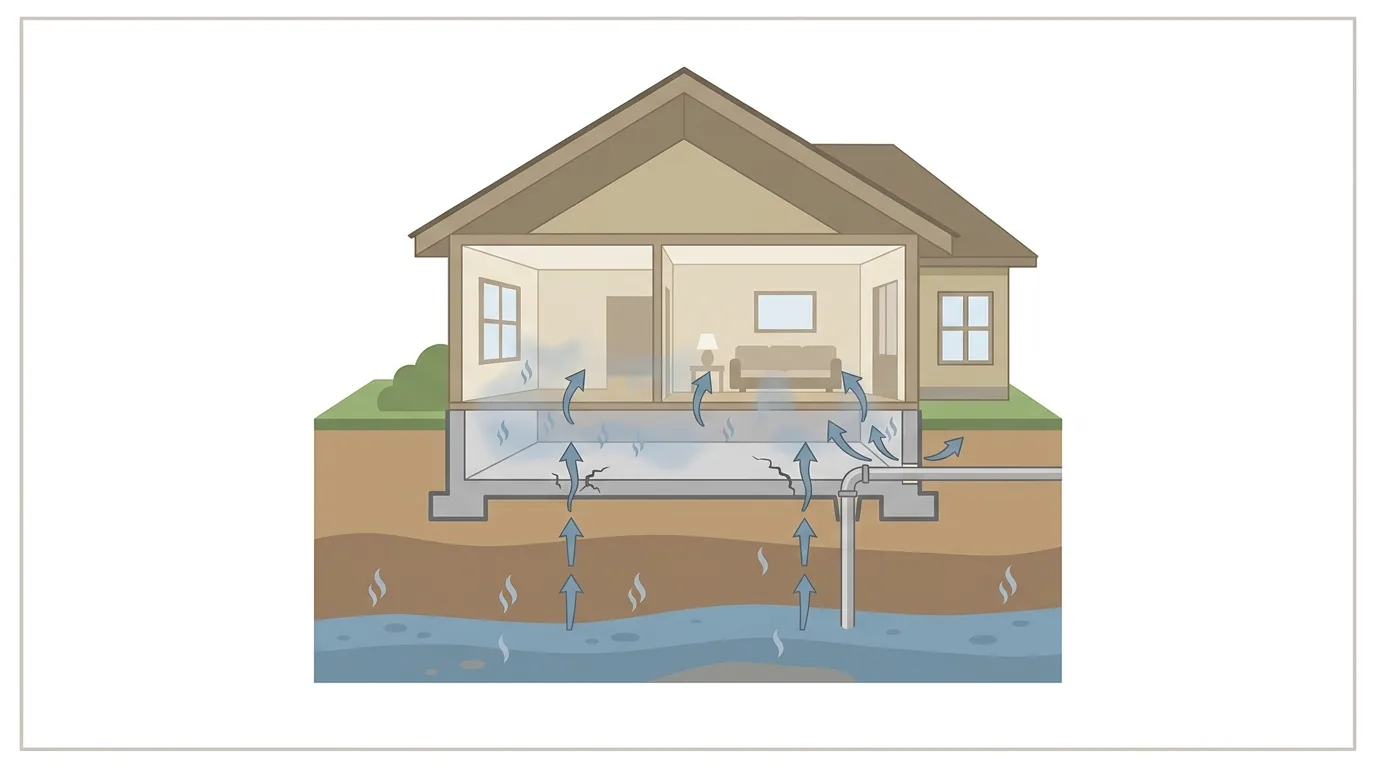
Vapor intrusion is chemical vapor moving from contaminated soil or groundwater into a building. Testing usually means sub-slab vapor samples plus indoor air samples, compared against Wisconsin screening levels. Mitigation is normally an active sub-slab depressurization system, sometimes paired with a barrier. In Wisconsin, screening is mandatory at contaminated sites, TCE gets priority treatment, and mitigation does not count as cleanup.
Vapor intrusion happens when chemical vapors from contaminated soil or groundwater rise through the ground and enter a building’s indoor air. The US EPA describes it as volatile chemicals migrating from contaminated groundwater or soil into a building above. It is the same physical pathway radon uses, but the contaminant is a manufactured chemical rather than a natural gas, and that difference changes almost everything about who investigates it, what the limits are, and who pays.
If you own or manage a commercial property in southeastern Wisconsin, this usually reaches you through a cleanup file, a sale, or a redevelopment plan, not through a smell or a symptom. Wisconsin requires screening for the vapor pathway at every contaminated site in the state, so the question tends to arrive as a letter from a consultant rather than a complaint from a tenant.
Table of Contents
What vapor intrusion actually is
Vapor intrusion is a pathway, not a chemical. Volatile compounds sitting in soil or dissolved in groundwater evaporate into the air spaces between soil particles. That soil gas then moves toward areas of lower pressure, and a heated building is one of the lowest pressure spaces around it.
The compound doing the damage is usually one of a short list. Chlorinated solvents such as trichloroethylene (TCE) and tetrachloroethylene (PCE) show up around former degreasing operations, machine shops, and dry cleaners. Petroleum compounds such as benzene show up around leaking underground storage tanks and old fuel handling. Methane and other landfill gases behave similarly but are managed under different rules.
None of this is radon. Radon is a naturally occurring radioactive gas that forms in soil and rock everywhere, which is why it is treated as a homeowner problem rather than a liability problem. If you are new to that side of it, our explainer on what radon is and why it is dangerous covers the basics, and where radon comes from walks through the soil chemistry.
Where the vapors come from in southeastern Wisconsin
The sources are industrial history. Milwaukee County and the surrounding counties have a dense layer of former manufacturing, metal finishing, printing, and fuel storage sites, plus decades of small dry cleaners in neighborhood retail strips. Wisconsin runs a dedicated Dry Cleaner Environmental Response Fund precisely because PCE releases from those operations are common enough to need their own program.
Common source categories:
- Former or active dry cleaners, where PCE has soaked into soil beneath or beside the building
- Metal fabrication and degreasing operations that used TCE as a solvent
- Leaking underground storage tanks at current and former fuel sites
- Closed landfills and old fill material under redeveloped parcels
- Manufacturing sites with historical floor drains discharging to soil
Important point that catches owners off guard: the release does not have to be on your parcel. Contaminated groundwater moves. A plume from a property a block away can pass under a building that has never stored a drum of anything.
How vapors get from the soil into a building
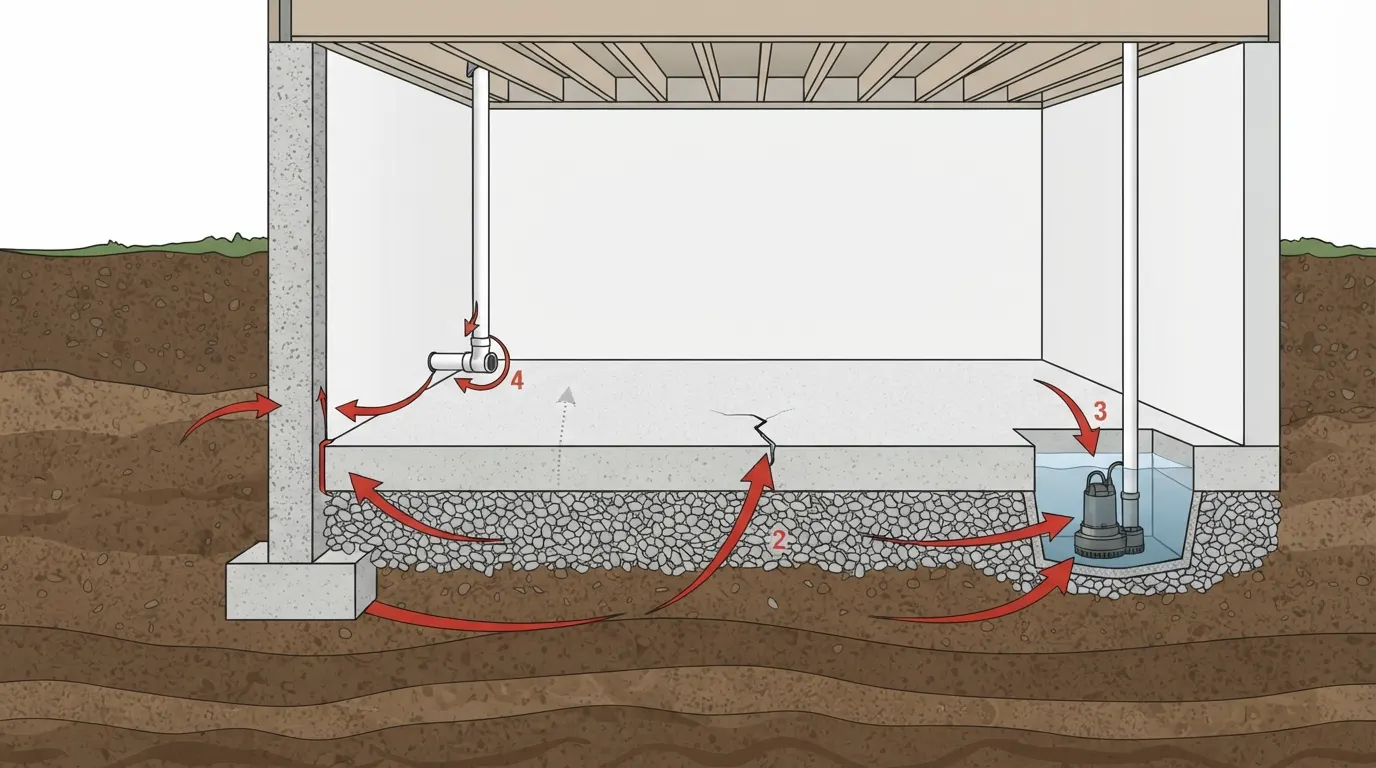
Buildings pull soil gas in. Warm indoor air rises and escapes through the upper floors and roof, which leaves a slight negative pressure at the lowest level. That pressure difference draws soil gas up through whatever openings exist in the foundation.
Typical entry points:
- Cracks and cold joints in slabs and foundation walls
- Utility penetrations for water, sewer, gas, and electrical service
- Sumps, floor drains, and elevator pits
- Expansion joints and unsealed slab edges
- Earthen crawl spaces and unsealed dirt floors
Wisconsin also treats human-made corridors as a distinct risk. Sanitary sewers and utility trenches can carry vapor sideways for long distances and deliver it into a building that sits nowhere near the plume itself. The DNR publishes separate guidance on documenting these preferential pathways, including a sanitary sewer gas screening level, because a building can test clean at the slab and still have a sewer-borne problem.
The pressure mechanics here are identical to radon. If you want the underlying physics in plainer terms, our piece on whether radon is heavier than air explains why soil gas behaves the way it does under a slab.
Why is vapor intrusion dangerous?
The risk depends entirely on which chemical is present and at what concentration. Two different exposure clocks matter, and mixing them up is the most common mistake in early conversations with tenants.
Chronic risk is the long exposure clock. Years of low-level exposure to a carcinogen such as TCE, PCE, or benzene raises cancer risk. This is the usual driver for mitigation decisions and it is why screening levels are set so low.
Acute risk is the short clock, and in Wisconsin it belongs almost entirely to TCE. The Wisconsin DNR flags TCE for priority handling because of its potential to cause health effects over short exposure periods, and an interim action can be required rather than a scheduled response. The Wisconsin Department of Health Services publishes dedicated TCE fact sheets for exactly this reason, including versions for workplace settings.
What this means in practice: a TCE detection above the action level in an occupied building is not a next-quarter item. It moves to the front of the queue, and the response can include ventilation or temporary measures while a permanent system is designed.
There is no smell test for any of this. Some of these compounds have odor thresholds far above their health-based limits, which means a building can be well over the action level and smell completely normal. Detection is a lab exercise, not a nose exercise.
What Wisconsin requires under RR-800 and the NR 700 rules
Screening for vapor intrusion is required at every contaminated site in Wisconsin. That obligation sits in Wis. Admin. Code ch. NR 716, and the DNR states it plainly on its vapor intrusion resources page. This is the single most important thing for a property owner to understand, because it means the vapor pathway is not an optional add-on that a consultant can decline to look at.
The framework document is RR-800, Addressing Vapor Intrusion at Remediation and Redevelopment Sites in Wisconsin. It covers screening, investigation, immediate response, mitigation, and long-term stewardship, and it applies to sites where contaminated vapor has migrated or could migrate into current or future buildings.
Two consequences of that wording are easy to miss:
- Future buildings count. A vacant parcel with a plume under it carries a vapor obligation into the design of anything built there later, which is why redevelopment planning now has to consider vapor controls early rather than at permit stage.
- Mitigation is not remediation. The DNR is explicit that installing a system controls exposure but does not clean up the release. The source obligation stays open, and closure carries continuing obligations.
That second point drives most of the arguments between buyers and sellers. A mitigation system makes a building safe to occupy. It does not make the file go away. Case closure with residual contamination brings its own continuing obligations, documented separately by the DNR.
Regulatory note: Wisconsin has no state licensing program for radon or vapor contractors. The DNR recommends contractors certified through the National Radon Proficiency Program for vapor intrusion mitigation work. Certification, not a state license, is the credential to ask for.
How is vapor intrusion tested and measured?
Testing works from the source upward, and no single sample answers the question on its own. A defensible evaluation compares several sampling media against the applicable screening levels.
The main sampling types:
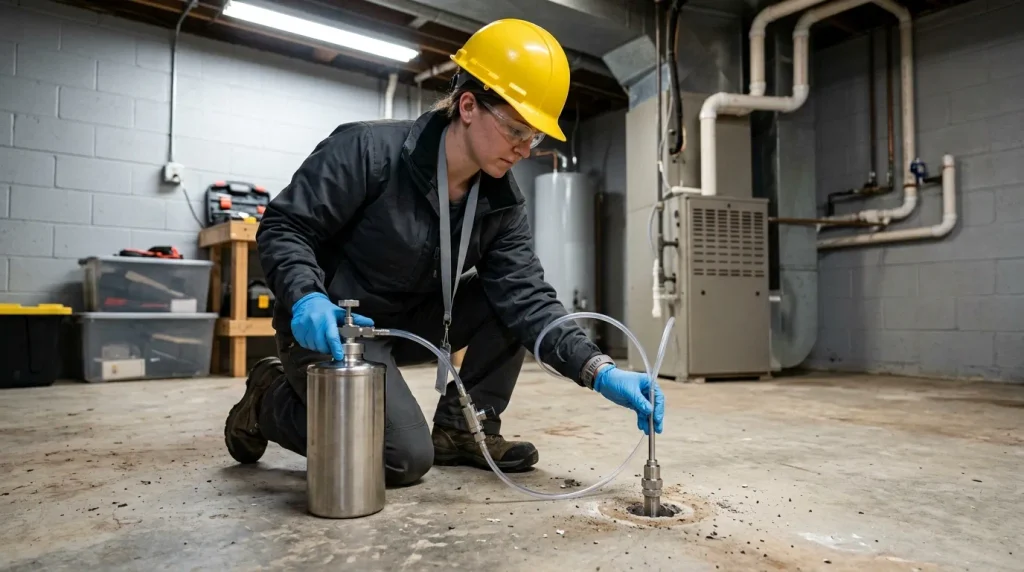
- Sub-slab vapor. A small port is drilled through the slab and soil gas is collected directly beneath the building. This is the workhorse sample for most buildings.
- Indoor air. Air is collected inside the occupied space, usually over 8 or 24 hours depending on land use.
- Exterior soil gas. Probes placed outside the building footprint help map the vapor field and support source identification.
- Groundwater. Used at the screening stage to judge whether a vapor pathway is plausible before anyone drills a slab.
Results get compared against Wisconsin’s own lookup values. The DNR publishes indoor air vapor action levels (VALs) and vapor risk screening levels (VRSLs) for sub-slab, soil gas, and groundwater, built on EPA’s Regional Screening Levels and broken out separately for residential, small commercial, and large commercial or industrial buildings. Those tables and the accompanying attenuation factors live on the DNR vapor intrusion resources page.
The number that connects a sub-slab result to an indoor air prediction is the attenuation factor. EPA’s default is 0.03 for sub-slab and near-source soil gas, and 0.001 for groundwater. In practice that means the target sub-slab concentration is about 33 times higher than the target indoor air concentration for the same chemical.
| Sampling medium | What it tells you | Default EPA attenuation factor |
| Sub-slab vapor | Concentration directly under the building, the most direct predictor of indoor exposure | 0.03 |
| Near-source soil gas | Vapor field outside the footprint, useful for delineating the source | 0.03 |
| Groundwater | Whether a vapor pathway is plausible at all, used for early screening | 0.001 |
| Indoor air | Actual exposure, but includes indoor background sources such as cleaners and fuels | Not applicable, this is the measured endpoint |
The indoor air caveat matters. Household and workplace products contain many of the same VOCs, so a positive indoor result does not by itself prove the vapors came from below. That is why sub-slab and indoor air samples are read together rather than in isolation.
Vapor intrusion and radon: the same pathway, different problem
These two get conflated constantly, including by people who should know better. The pathway is genuinely the same. Almost nothing else is.
| Radon | Chemical vapor intrusion | |
| Source | Natural uranium decay in soil and rock | A human release of solvents or fuel |
| Contaminant | A radioactive noble gas, not a VOC | Volatile organic compounds such as TCE, PCE, benzene |
| Who is responsible | The property owner, since the source is natural | Often the responsible party for the release, not the building owner |
| Benchmark | EPA action level of 4 pCi/L | Wisconsin VALs and VRSLs, chemical by chemical |
| Detection | Continuous monitor or lab test kit measuring radioactivity | Lab analysis of collected vapor samples for specific compounds |
| Oversight | Voluntary in Wisconsin, no state licensing | Regulated under ch. NR 700 with DNR oversight |
| Typical fix | Active sub-slab depressurization | Active sub-slab depressurization, often with a barrier and monitoring |
The practical overlap is real, though. A building can have both, and a well-built radon system is often the starting point for a vapor system. If radon is your actual concern, start with how radon mitigation systems work in Milwaukee and the types of radon mitigation system instead of this page.
A common follow-on question: does an existing radon system already handle chemical vapors? Sometimes partly, often not. Radon systems are designed for a natural gas with a single benchmark, not for documented chemical concentrations with regulatory reporting attached. Coverage, vacuum field, materials, and monitoring all have to be re-evaluated against the vapor data before anyone can say the existing system is adequate.
How vapor intrusion mitigation systems work
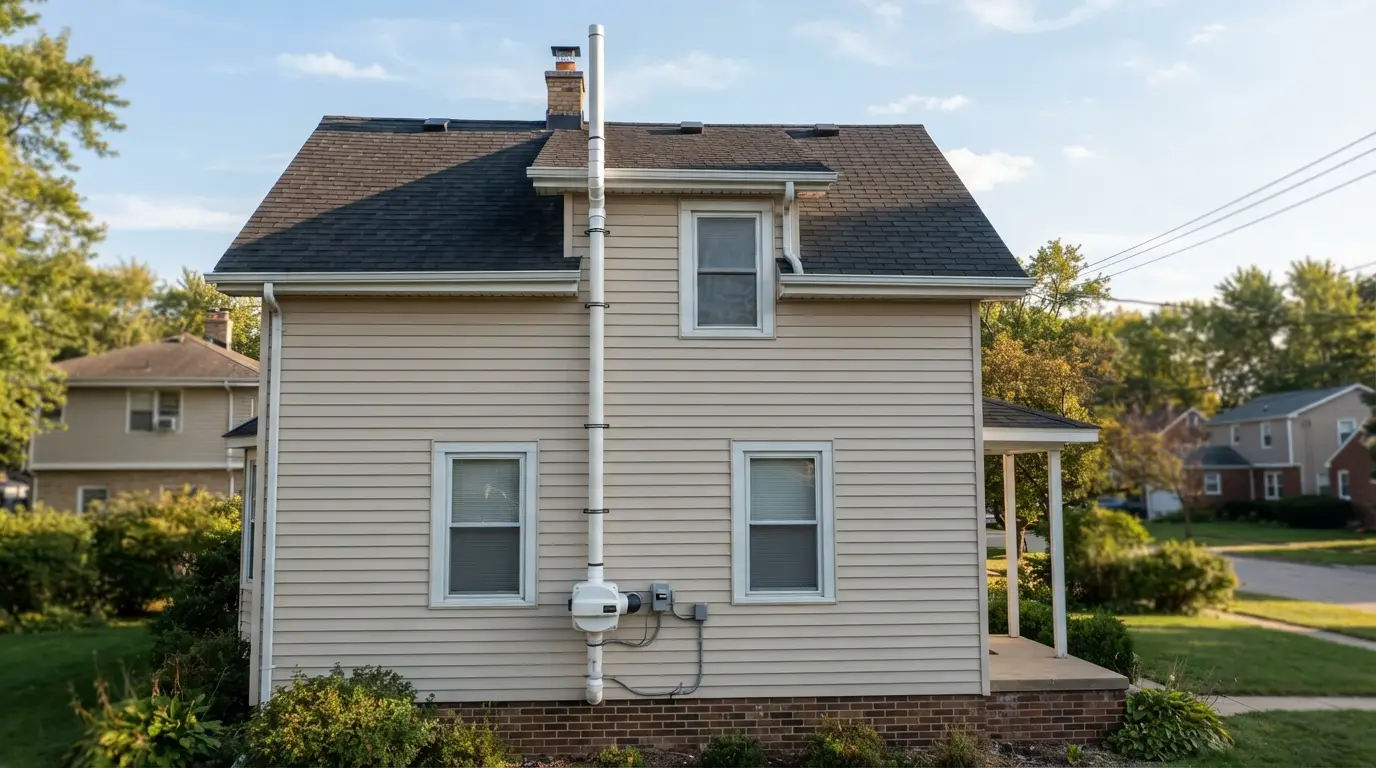
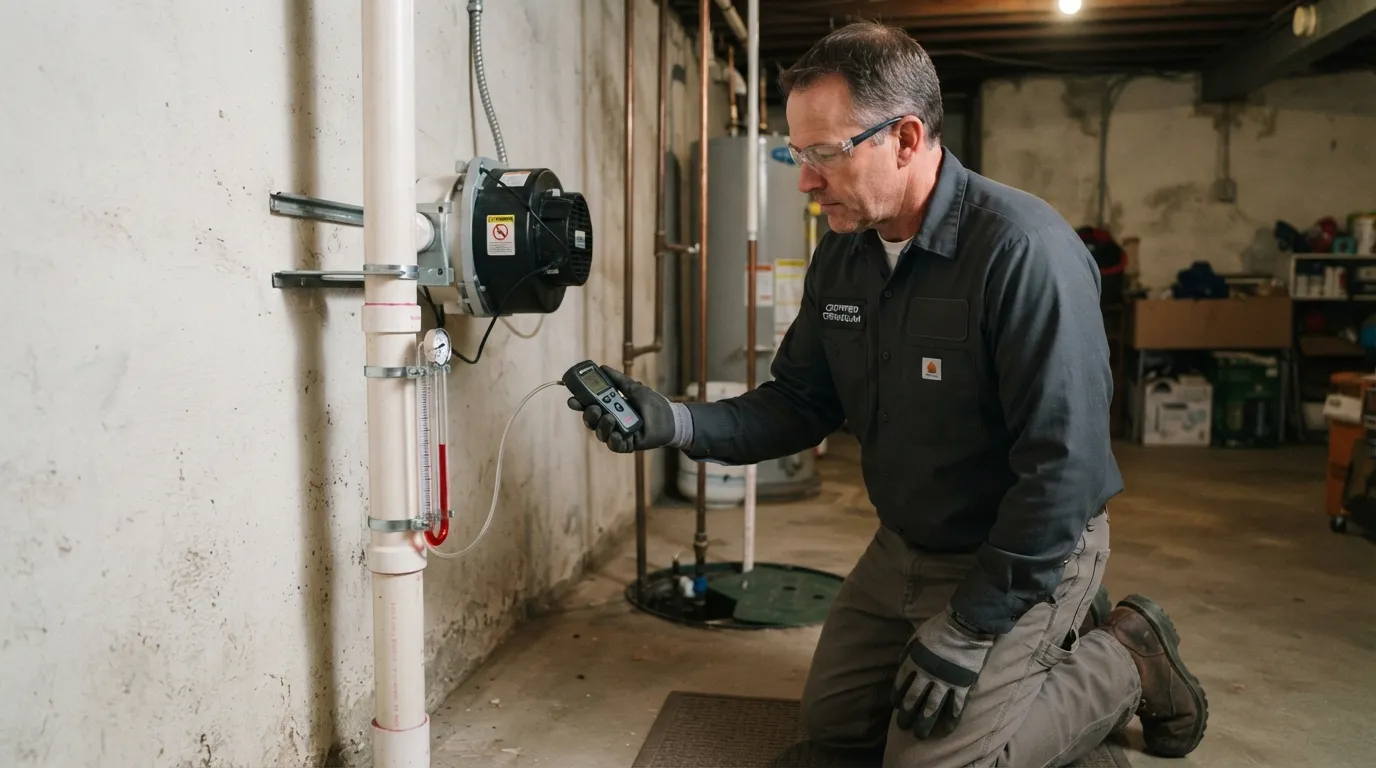
The standard solution is active sub-slab depressurization, usually shortened to ASD. A fan pulls a slight vacuum on the space beneath the slab, so soil gas moves into the piping and out above the roofline instead of into the building.
A typical commercial system includes:
- One or more suction points cut through the slab, sized and placed to hold a vacuum field across the whole footprint
- Sealed piping routed to a discharge point above the roof
- A fan selected for the airflow and static pressure the building actually needs
- Sealing of cracks, joints, sumps, and utility penetrations so the vacuum is not wasted
- Pressure monitoring, and on higher-risk buildings, alarms or telemetry
Barriers are a supporting element, not usually a standalone answer. A membrane under a new slab reduces diffusion, but it cannot manage pressure and it cannot be inspected once the concrete is poured. Wisconsin and EPA guidance both treat barriers as part of a system rather than a replacement for one. The same logic applies on the radon side, which is why a crawl space liner alone rarely brings levels down without a fan pulling on it.
Where a building has not been constructed yet, the economics change completely. Installing the pipe and membrane during construction is far cheaper than retrofitting an occupied facility later. That is the same argument behind radon-resistant new construction, and the design principles carry over almost directly.
Design standards come from the ANSI/AARST soil gas standards, published by the organization now operating as the Indoor Environments Association. The DNR points to those standards directly for mitigation best practices.
Who should perform vapor intrusion work in Wisconsin?
The work splits into two roles, and confusing them is expensive.
Investigation and regulatory reporting under ch. NR 700 is environmental consulting. It covers site investigation work plans, sampling design, data interpretation against VALs and VRSLs, DNR submittals, and case closure documentation. This is consultant territory.
Mitigation system design and installation is contractor work. For that half, the DNR recommends using contractors certified through the National Radon Proficiency Program. That recommendation exists because soil gas mitigation is the same craft whether the gas is radon or a solvent, and the certification path runs through the radon industry.
Questions worth asking any firm before you sign:
- Are you NRPP or NRSB certified, and can you show current credentials?
- Have you designed multi-point systems for occupied commercial buildings, not just houses?
- Do you install to the ANSI/AARST soil gas standards?
- Will you coordinate with our environmental consultant and the DNR project manager?
- What does your post-installation verification and documentation package include?
Wisconsin does not license radon or vapor contractors at the state level, so there is no state credential to check. That places the burden on you to verify certification directly. MRH’s vapor intrusion services are led by Brian Thompson, an AARST and NRPP certified specialist working across commercial and industrial properties in the Milwaukee area.
What happens after the system is installed
A vapor mitigation system is a long-term obligation, not a one-time purchase. It only protects occupants while it is actually running, and a failed fan is silent.
Ongoing requirements typically include:
- Annual system inspections, documented on DNR Form 4400-321, the Vapor Mitigation System Inspection Log
- A written operation, monitoring, and maintenance plan covering parameters, thresholds, and who gets notified
- Active notification through audible alarms or visual indicators on essentially all active systems
- Telemetry and backup power where acute risk and multi-family occupancy overlap, particularly with TCE
- Continuing obligations that survive case closure and follow the property
The DNR’s telemetry best practices are specific. Alerts should be sent within four hours of a system failure, and thresholds should be set to catch a meaningful change in vacuum from the established baseline rather than waiting for total failure.
If that sounds like the annual radon system check, it is the same discipline with more paperwork. Our article on why annual radon system inspections are critical makes the case for the maintenance habit, and MRH’s radon system inspection service covers the residential and light commercial version of this work.
When property owners usually run into vapor intrusion
It rarely starts with a health concern. It starts with a transaction or a file.
- During a sale. A Phase I environmental site assessment identifies a nearby release, and a vapor encroachment screen under ASTM E2600 flags the possibility of vapors reaching the property.
- During a cleanup. An active NR 700 site triggers mandatory vapor screening, and the building sits inside the area of concern.
- During redevelopment. A brownfield parcel needs vapor controls designed into the new slab before construction starts.
- During leasing. A prospective tenant’s due diligence turns up an open file, or an existing tenant asks what the pipe on the wall is for.
- After a neighbor’s investigation. A responsible party sends an access request letter asking permission to sample your building.
That last one surprises people most. Receiving an access request does not mean your property is contaminated. It means someone else’s plume may extend under it, and they are obligated to find out.
FAQ
Does cold Wisconsin weather make vapor intrusion worse?
It generally increases it. Heating a building widens the indoor and outdoor temperature gap, which strengthens the stack effect and pulls harder on the soil beneath the slab. Frozen or snow-covered ground can also cap the surface and push more soil gas toward the building instead of letting it vent naturally. Winter sampling often produces higher results than summer sampling in the same building, which is why seasonal timing gets written into sampling plans.
Can a building on clean land still have vapor intrusion?
Yes, and this is the most common misunderstanding. Groundwater carries dissolved contamination away from the original release, and vapor can also travel sideways through sewer lines and utility trenches. A property with no spill history of its own can sit above a plume that started several parcels away.
Who pays for vapor intrusion mitigation, the owner or the responsible party?
It depends on who caused the release, and it is a legal question rather than a technical one. Where a responsible party is identified for an off-site release, the cost of investigating and mitigating affected buildings often falls to them. Where no responsible party exists, or where the release originated on the property, the owner usually carries it. Radon is different again, since a natural source has no responsible party. Get advice from an environmental attorney before agreeing to anything in writing.
Can I use a consumer air quality monitor to check for vapor intrusion?
No. Consumer VOC monitors report a single combined reading in units that cannot be compared to a chemical-specific action level. Vapor action levels are set for individual compounds at concentrations far below what these devices can resolve. Evaluating the vapor pathway requires collected samples analyzed by a laboratory.
Will a vapor barrier on its own stop chemical vapors?
Usually not by itself. A membrane slows diffusion through the slab, but it does nothing about the pressure difference that actively pulls soil gas inward, and any seam, penetration, or tear becomes a pathway. Barriers work as one layer inside a system that also depressurizes the sub-slab space. The same limitation applies to radon, where a crawl space liner without a fan rarely brings levels down on its own.
Conclusion
If a consultant, a lender, or a DNR letter has raised the vapor pathway on your property, the sequence is straightforward. Confirm what the existing environmental file already says. Get sub-slab and indoor air data if it does not exist yet. Compare the results against the Wisconsin lookup values for your building’s land use. Then design a system sized for the actual footprint rather than a house-scale template.
Milwaukee Radon Mitigation designs and installs vapor intrusion mitigation systems for commercial and industrial properties across Milwaukee, Waukesha, and Ozaukee counties. To talk through a specific building, see our vapor intrusion mitigation services or request a free quote. You can also call (414) 455-7279 or get in touch with the team.