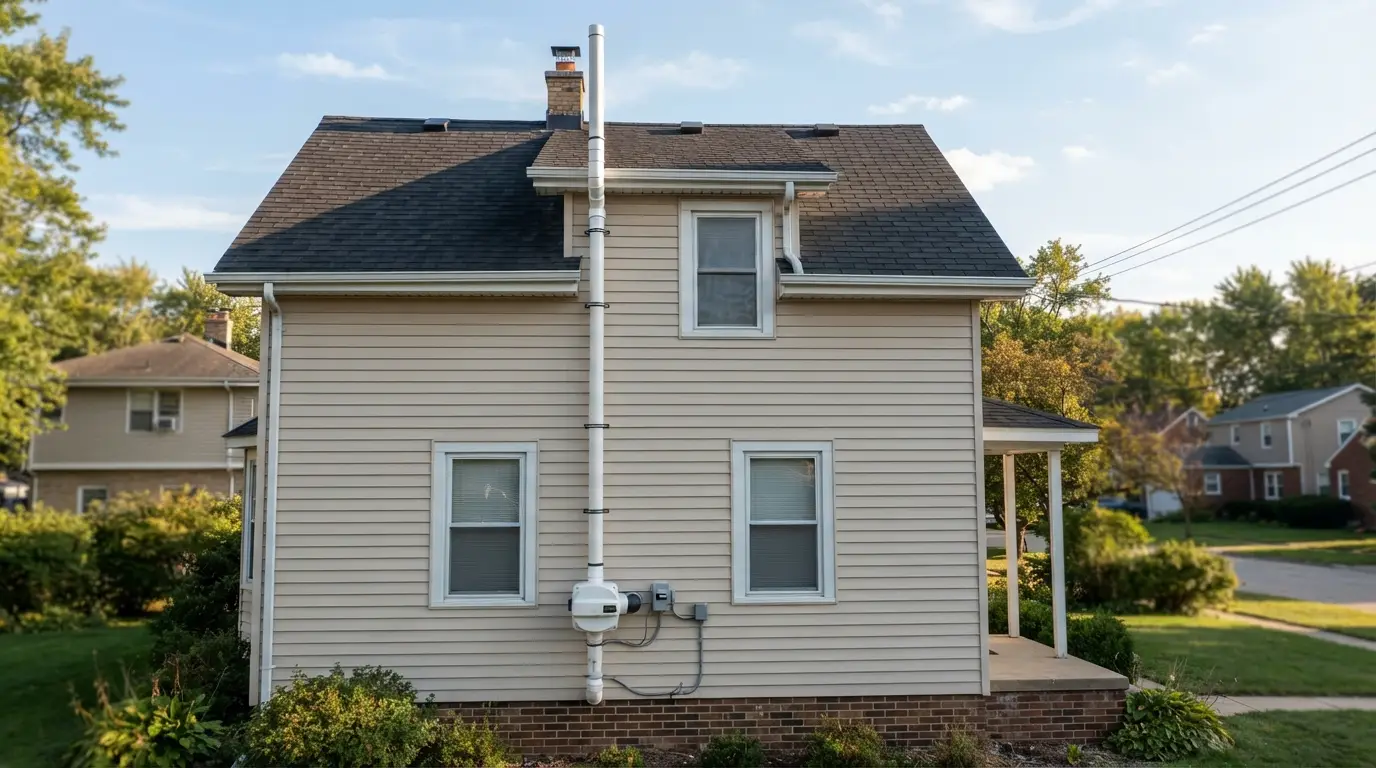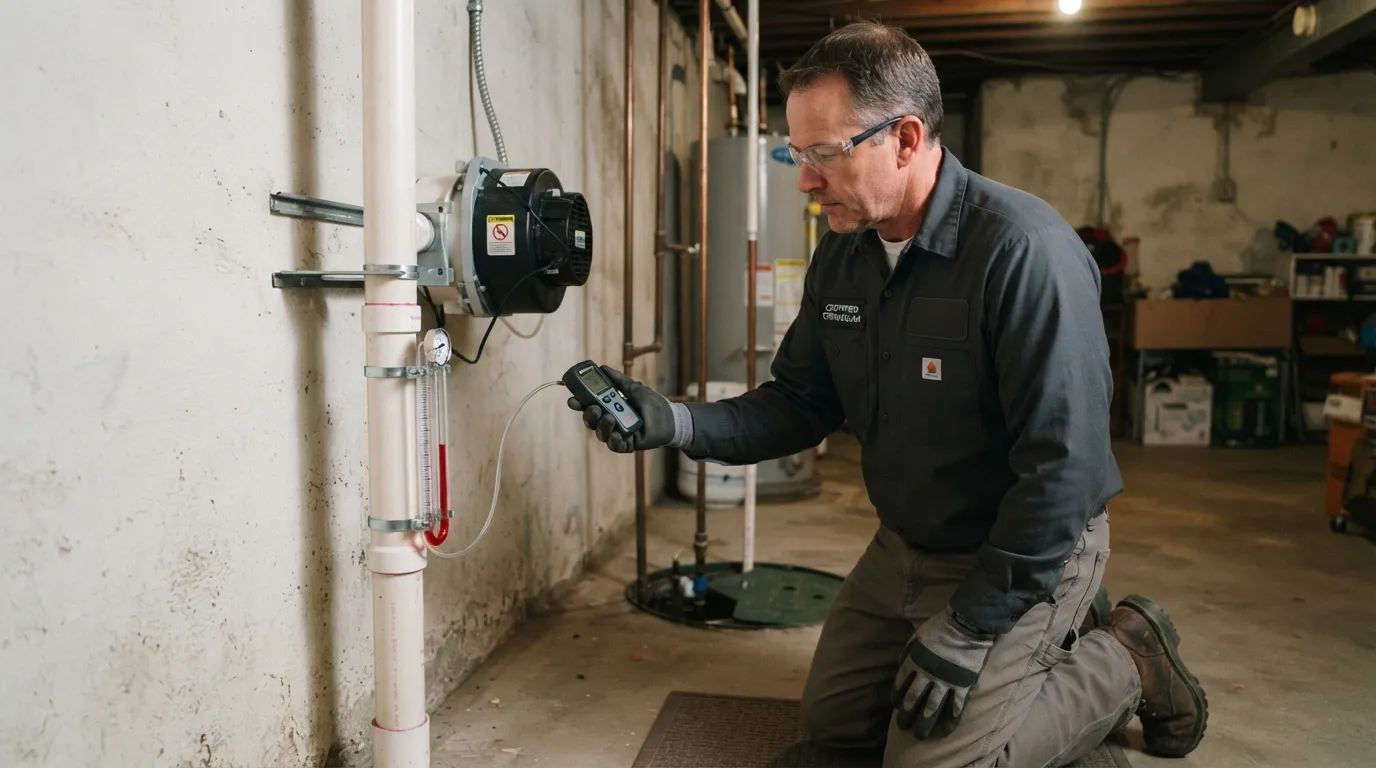

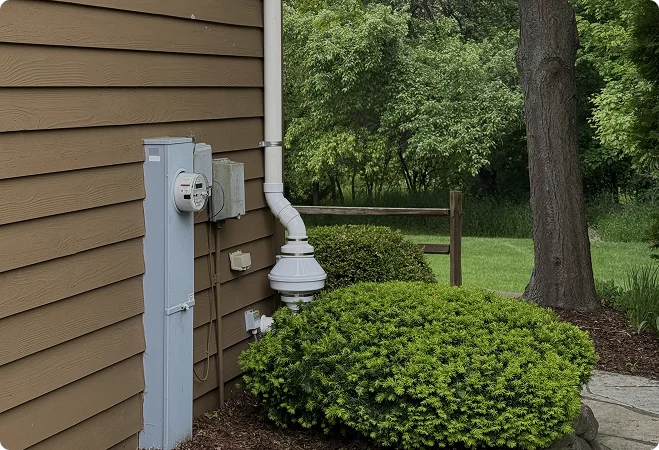
Quick answer: A radon fan is a sealed inline fan that powers an active radon mitigation system. It creates suction under your foundation and pushes soil gas up a PVC pipe to vent above the roof. It runs 24/7 and is installed outside the living space. Milwaukee Radon Mitigation (Brian Thompson, NRPP-certified radon measurement and mitigation professional, West Allis, WI) installs and services radon fans.
Key takeaways
- A radon fan is not a bathroom fan. It is a sealed, moisture-rated inline fan built to run continuously.
- It goes in the attic, garage or on an outside wall, never in the basement or living space.
- Fan size is matched to the soil under your slab: too small leaves radon high, too big wastes power and adds noise.
- The manometer on your pipe tells you at a glance whether the fan is pulling.
- Fans are the one part of a system that wears out, typically after 7 to 12 years in Brian’s experience.
In this guide
- What a radon fan is
- How does a radon fan work?
- Where a radon fan goes, and where it must not
- How radon fans are sized
- Radon fan installation, step by step
- What it costs to run
- Keeping your fan healthy
- Radon fans in Wisconsin weather
- FAQ
What a radon fan is
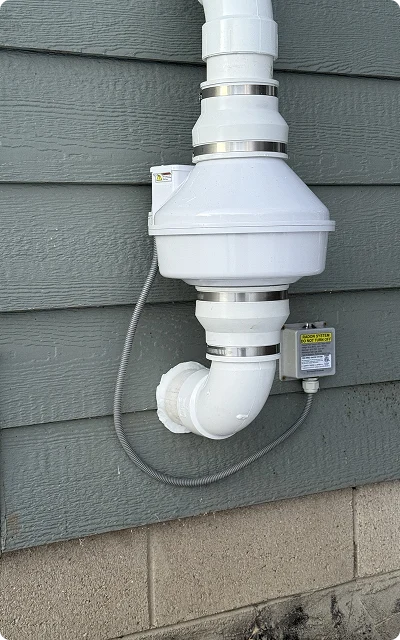
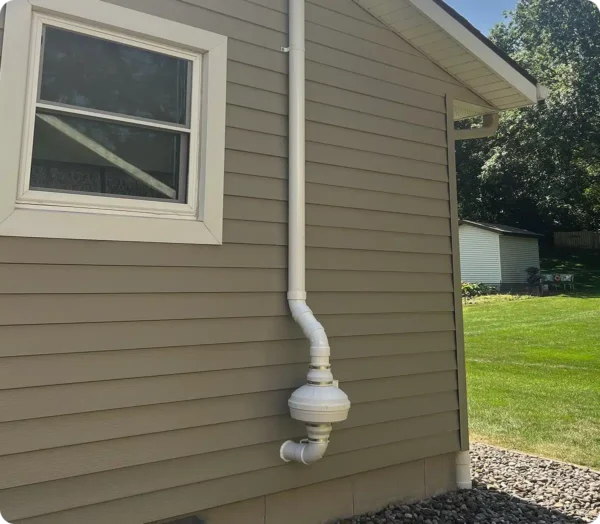
A radon fan is a compact, round inline fan that fits directly into the system’s PVC pipe, usually with rubber couplings on each end. It is built differently from a household ventilation fan:
- Sealed housing, so soil gas cannot leak out of the fan itself.
- Moisture and weather rated, because soil gas is damp and many fans live outdoors.
- Continuous duty, designed to run all day, every day, for years.
Without a fan, a radon pipe is a passive vent that relies on natural draft. With a fan, it becomes an active system, which is far more predictable.
How does a radon fan work?
The fan spins an impeller that pulls air from the pipe below it and pushes it out the pipe above it. That does two jobs at once:
- On the suction side (between the slab and the fan), it lowers the pressure under your foundation. Soil gas flows toward the suction point instead of up through cracks into your basement.
- On the exhaust side (between the fan and the roof), it pushes that gas out above the roofline, where it dilutes outdoors.
This is why location matters so much. The exhaust side of the pipe is under positive pressure. If that section ran through your living space and had a small leak, it would push radon into the house. Keeping the fan outside the living space keeps any pressurized pipe outside it too. For the full system picture, see how radon mitigation systems work.
Where a radon fan goes, and where it must not
| Location | OK? | Notes |
|---|---|---|
| Outside wall | Yes | Common on exterior systems; easy to service; exposed to weather |
| Attic | Yes | Common on interior systems; quieter outdoors; needs attic access |
| Garage (not under living space) | Yes | Pipe continues through the garage roof |
| Basement | No | Pressurized pipe would run through the house |
| Living space or closet | No | Same reason; also noise |
| Crawl space under the house | No | Counts as part of the building envelope |
ANSI/AARST standards also require the exhaust to end above the roof edge and away from windows, doors and other openings.
How radon fans are sized
Radon fans come in a range of sizes, from low-power models for open, gravelly soil to high-suction models for tight clay or large slabs. The goal is the smallest fan that gets your level well below 4.0 pCi/L. In Brian’s installs, fans typically draw about 40 to 120 watts depending on the home and fan, on pipe that is typically 3 to 4 inches.
Sizing is based on diagnostics during the install visit: how much air moves under the slab and how far the suction reaches. A fan that is too small leaves some rooms high. A fan that is too big costs more to run, can be noisy, and can pull more conditioned air out of the house than needed.
Radon fan installation, step by step
Whether it is part of a new system or a swap on an existing one, a professional radon fan installation follows the same sequence:
- Confirm the location. Outside the living space, with room to service the fan later.
- Check the pipe. Diameter, slope and joints are inspected so the fan is not fighting a leak or a water trap.
- Mount and couple. The fan is set vertically in the pipe and joined with rubber couplings and clamps. Couplings absorb vibration and let the fan be removed.
- Support it. Brackets or straps carry the fan’s weight so it does not hang on the pipe joints.
- Power it. An outdoor-rated disconnect or dedicated connection is installed where needed. A licensed electrician makes the electrical connection.
- Set the manometer. The gauge reading is marked on day one so you can spot changes later.
- Test. A post-mitigation test, no sooner than 24 hours and no later than 30 days after start-up, confirms the fan is doing its job. On our installs it is included.
Step 2 is where swaps on older systems often go wrong. A new fan on a pipe that traps water, leaks at a joint or exhausts too low will not fix the underlying problem, and the new fan may not last. If your fan has stopped, see our radon fan replacement service.
What it costs to run
A radon fan uses electricity 24 hours a day. You can work out your cost:
- Read the wattage on the fan label.
- Watts × 24 × 365 ÷ 1,000 = kWh per year.
- kWh per year × your rate per kWh (on your We Energies bill) = yearly cost.
Worked example: in Brian’s experience, radon fans draw about 40 to 120 watts depending on the home and fan. That is roughly 350 kWh a year at 40 watts and 1,050 kWh at 120 watts. Multiply by your rate for the yearly cost.
The system also pulls a small amount of conditioned air through the slab. Good sealing keeps that low.
Keeping your fan healthy
Radon fans need very little care, but a quick monthly glance helps:
- Manometer: still uneven and near the mark set at install?
- Sound: a steady, low hum, not a rattle, grind or whine?
- Power: the fan’s switch or breaker on? (Fans sometimes get switched off by accident.)
- Outside: no damage to the fan or pipe, exhaust clear of ice and debris?
- Retest: every 2 years, as EPA recommends.
Fans are motors with bearings, and they do wear out, typically after 7 to 12 years in Brian’s experience. The fans we install carry a 5-year warranty. Our guide on how long radon fans last covers the warning signs. If your fan is noisy, see radon fan noise.
Radon fans in Wisconsin weather
A radon fan in Greater Milwaukee works through humid summers and sub-zero winters. Three things matter here:
- Condensation. Warm, damp soil gas meets a cold pipe and condenses. The pipe must slope so water drains back down rather than collecting at the fan.
- Ice. On exterior systems, frost can form at the top of the stack during long cold snaps. Pipe size and routing help keep the exhaust open.
- Snow and access. An exterior fan should be mounted high enough to stay clear of drifts and still be reachable for service.
Melissa O. checked in two months after her install and said the system was working perfectly. The real test for a fan here is the first January, so check the manometer after the first deep freeze.
Wisconsin DHS reports that about 1 in 10 Wisconsin homes has high radon, so many Milwaukee-area houses already have a fan running. We service them throughout the area, including radon mitigation in Franklin and the south suburbs.
Is your radon fan quiet, loud, or not running at all?
Brian can check your fan, pipe and manometer and tell you honestly whether it needs anything.
FAQ
Do radon fans really work?
Yes. A radon fan is what turns a vent pipe into an active system, and active sub-slab depressurization is the method EPA describes as most common for homes with basements and slabs. It works when the suction point is sealed, the fan is sized to the soil, and the result is confirmed by a test. Our customers have seen drops from about 9.5 to 0.30 pCi/L. In Brian’s experience, typical results are below 2.0 pCi/L, with more than 90% of homes below 1.0 pCi/L.
Where should a radon fan be installed?
A radon fan should be installed outside the living space: on an exterior wall, in the attic, or in a garage that is not under living space. It should never be in the basement or inside the home, because the pipe above the fan is under positive pressure. The exhaust should end above the roof edge, away from windows and doors.
How does a radon fan work?
A radon fan is an inline fan in the system’s PVC pipe. It pulls air from under your slab, lowering the pressure there so soil gas flows into the pipe instead of your home. It then pushes that gas up and out above the roof. It runs continuously, and the manometer on the pipe shows it is pulling.
Do radon fans need maintenance?
Very little. Check the manometer and listen for a steady hum once a month, keep the exhaust clear of ice and debris, and retest every 2 years. Fans are sealed and not designed to be oiled or opened. When a fan gets loud or the manometer drops to zero, it usually needs replacing. Brian carries spare fans for same-visit swaps, which usually take under an hour, and offers 24/7 emergency fan service.