
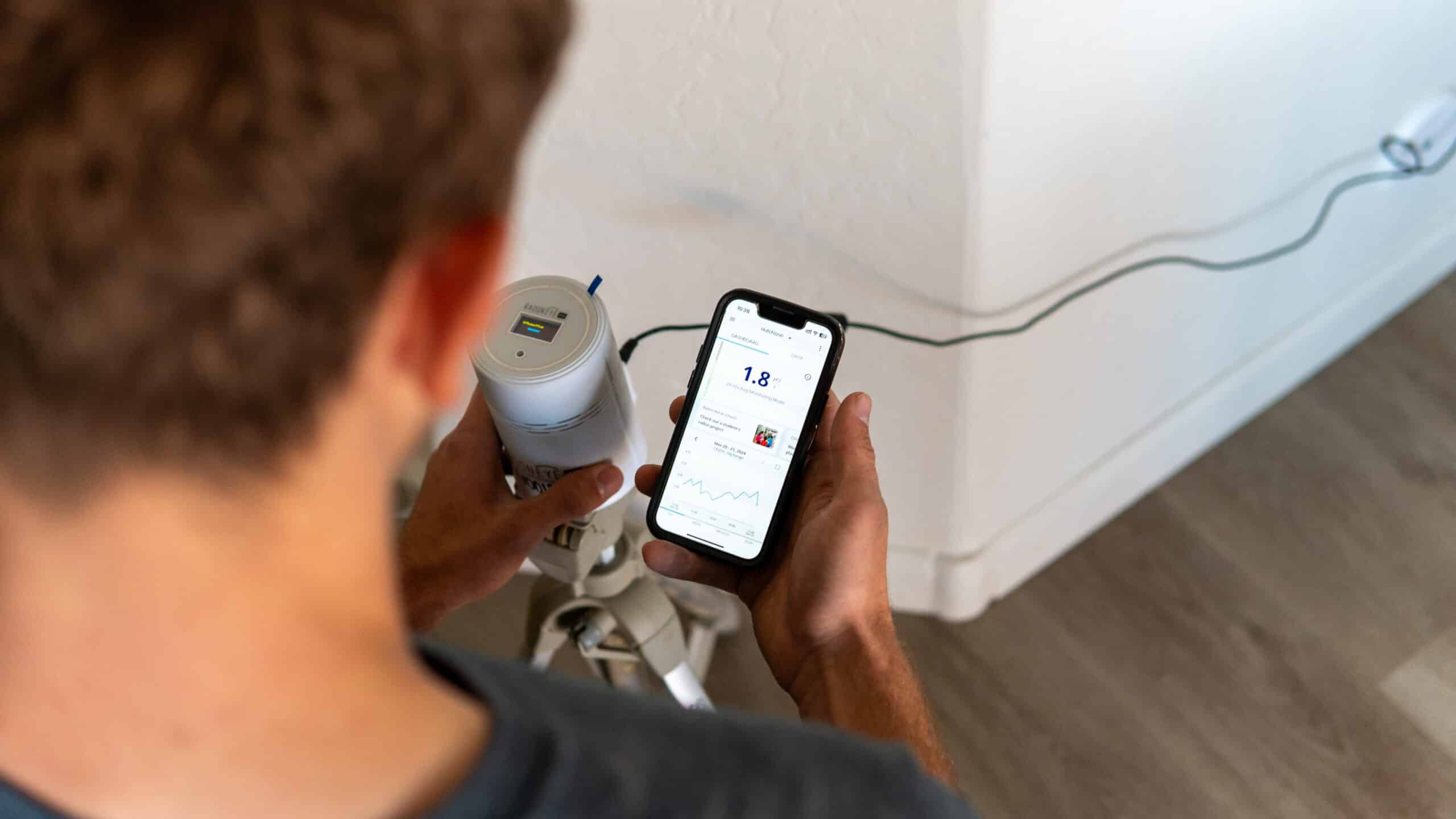
Quick answer: pCi/L stands for picocuries per liter, the U.S. unit for radon in air. It measures how much radioactive decay happens in each liter of air. EPA recommends fixing a home at 4.0 pCi/L or higher and considering a fix from 2.0 to 3.9. The average U.S. home is about 1.3 pCi/L, per EPA.
Key takeaways
- 1 pCi/L means about 2.2 radioactive decays per minute in every liter of air.
- 4.0 pCi/L is EPA’s action level; it’s not a “safe” line, it’s the point where EPA recommends fixing.
- No radon level is completely risk-free, according to EPA. Lower is better.
- Outside the U.S., radon is usually reported in Bq/m³. 1 pCi/L = 37 Bq/m³.
- Mitigation systems often bring levels well under 4. Customer results we’ve seen include about 9.5 down to about 0.30 pCi/L.
In this guide
- What pCi/L means
- A radon level chart: what each number means
- What is a safe radon level?
- Is radon level 4 the magic number?
- pCi/L vs. Bq/m³ (and WHO’s reference level)
- How to read your radon test report
- Radon numbers in Wisconsin
- FAQ
What pCi/L means
A curie is a unit of radioactivity, named after Marie and Pierre Curie. A picocurie (pCi) is one trillionth of a curie, a very small amount. Per liter (/L) means per liter of air.
Put together, pCi/L tells you how much radioactive decay is going on in a liter of air in your home. One picocurie equals about 2.2 decays per minute. So a reading of 4.0 pCi/L means roughly 9 radon atoms are decaying every minute in each liter of air you breathe.
That sounds small, and in one breath it is. The concern is the total over months and years: thousands of breaths a day, every day, in the same house.
A radon level chart: what each number means
| Radon level | What it means | What EPA guidance suggests |
|---|---|---|
| About 0.4 pCi/L | EPA’s estimate of average outdoor air | Baseline; indoor levels can’t go below outdoor air |
| About 1.3 pCi/L | EPA’s estimate of the average U.S. indoor level | Below the action level; retest after major changes |
| 2.0–3.9 pCi/L | Below the action level but above average | EPA suggests considering a fix, especially for smokers or heavy basement use |
| 4.0 pCi/L | EPA action level | EPA recommends fixing the home |
| 4.1–7.9 pCi/L | Above the action level | Plan mitigation; confirm with a second test if it’s a borderline result |
| 8.0 pCi/L and up | Twice the action level or more | Mitigate; the higher the number, the sooner it’s worth acting |
Source: EPA, A Citizen’s Guide to Radon
What is a safe radon level?
There’s no level EPA calls perfectly safe. EPA’s view is that any radon exposure carries some lung cancer risk, and that risk goes up as levels and years of exposure go up.
So the honest answer to “what is a safe radon level” is: as low as you can reasonably get it. In practice:
- Below 2.0 pCi/L: many homeowners stop here. Retest every few years and after renovations.
- 2.0 to 3.9 pCi/L: worth a thoughtful look. Many families choose to fix, especially with a finished basement, kids, or a smoker in the house.
- 4.0 and up: EPA recommends fixing.
Because outdoor air already contains about 0.4 pCi/L, no system gets you to zero. A well-installed active sub-slab depressurization system can often bring a home well below 2.
Is radon level 4 the magic number?
Not really. 4.0 pCi/L is EPA’s action level, a practical line where EPA says the benefit of fixing is clear and mitigation is reliably able to help. It isn’t a cliff where risk suddenly appears.
A reading of 3.8 isn’t “safe” and 4.2 isn’t “dangerous” in any dramatic sense. Both are in the range where a fix makes sense to consider. When a short-term result lands close to 4, EPA suggests a follow-up test (a second short-term test, or a long-term test) before deciding.
pCi/L vs. Bq/m³ (and WHO’s reference level)
If you read radon information from Canada, Europe or the World Health Organization, you’ll see becquerels per cubic meter (Bq/m³). It’s the metric unit for the same thing.
| pCi/L | Bq/m³ (approx.) |
|---|---|
| 1.0 | 37 |
| 2.0 | 74 |
| 2.7 | 100 |
| 4.0 | 148 |
| 8.0 | 296 |
To convert: multiply pCi/L by 37 to get Bq/m³, or divide Bq/m³ by 37 to get pCi/L.
The World Health Organization recommends a national reference level of 100 Bq/m³, about 2.7 pCi/L, and no higher than 300 Bq/m³ where that isn’t achievable. That’s one reason many people aim for under 2.7 pCi/L even though the U.S. action level is 4.0.
You may also see Working Levels (WL) on some reports. WL measures radon decay products rather than radon gas itself. Most homeowner reports use pCi/L.
How to read your radon test report
A professional continuous radon monitor report usually shows two things (our tests use Ecosense RadonEye Pro monitors, and a written report is included):
- The average for the whole test period, in pCi/L. This is the number EPA guidance is based on.
- Hourly readings, shown as a graph. Levels rise and fall through the day, often higher overnight and early morning.
Don’t panic at a single high hour on the graph. The average is what matters for deciding on mitigation. The hourly graph is still useful: a steady pattern suggests normal soil-gas entry; sudden drops can show a window was opened or the device was disturbed.
A few things to check on any report:
- Test dates and duration (at least 48 hours for a short-term test, per Wisconsin DHS real estate guidance)
- Location in the home (lowest livable level)
- Closed-house conditions noted
- Device type and calibration date
- Tester name and certification (look for NRPP)
If your average is 4.0 or higher, our radon mitigation system service for Milwaukee homes explains how we bring it down. If you’re wondering what that costs, read our radon mitigation cost guide.
Radon numbers in Wisconsin
Wisconsin DHS estimates about 1 in 10 homes in the state has radon above the action level. For homes in Milwaukee and Waukesha counties, that means plenty of results land on both sides of 4.0. A few Wisconsin points that tie to these numbers:
- Real estate: Wisconsin doesn’t require a radon test to sell a home, but DHS highly recommends it, with at least 48 hours under closed-house conditions on the lowest livable level (DHS).
- Child care: since March 2023, licensed child care providers in Wisconsin must test and mitigate above 4.0 pCi/L.
- After a fix: EPA recommends retesting every 2 years.
What real results look like: Steve L. went from about 7.1 pCi/L to about 1.1 after his system. Andrew S. went from about 9.5 (peaking near 10) to about 0.30. Every home is different, so we never promise a specific number before testing and design.
If you’re in New Berlin or western Milwaukee County, our New Berlin, WI radon mitigation page covers local service.
Got a number and not sure what to do with it?
Send Brian your result. He’s an NRPP-certified radon measurement and mitigation professional, and he’ll tell you honestly whether it calls for a system, a retest or nothing at all.
FAQ
Is a radon level of 4 pCi/L safe?
4.0 pCi/L is EPA’s action level, the point where EPA recommends fixing your home. It isn’t a “safe” threshold. EPA says any radon exposure carries some risk and suggests considering mitigation between 2.0 and 3.9 pCi/L as well. If a short-term test lands near 4, a follow-up test helps confirm before you decide.
How bad is 8.0 pCi/L radon?
8.0 pCi/L is twice EPA’s action level of 4.0, so EPA would recommend fixing the home. It’s not an emergency that calls for moving out, but it’s worth planning mitigation rather than waiting. A properly designed sub-slab depressurization system can often bring levels like this well below 4. In Brian’s experience, typical post-mitigation results are below 2.0 pCi/L, with more than 90% of homes below 1.0 pCi/L. Retest after installation to confirm.
Is 1.3 pCi/L of radon bad?
No. 1.3 pCi/L is about EPA’s estimate of the average indoor radon level in U.S. homes, and well below the 4.0 action level. EPA still says lower is better, but most homes at this level don’t need mitigation. Retest after major renovations, finishing a basement, or every few years.
What is a picocurie?
A picocurie is one trillionth of a curie, a unit of radioactivity. One picocurie equals about 2.2 radioactive decays per minute. In radon testing, results are given in picocuries per liter of air (pCi/L), which tells you how much radon decay is happening in each liter of air in your home.
Sources
- EPA: A Citizen’s Guide to Radon
- EPA: Health Risk of Radon
- WHO: Radon and Health fact sheet
- Wisconsin DHS: Radon and Real Estate
- Wisconsin DHS: Radon