
Quick answer: Radon testing measures the amount of radon gas in your home’s air, reported in picocuries per liter (pCi/L). A device sits on the lowest livable level for at least 48 hours (short-term) or 90+ days (long-term). EPA recommends fixing homes that test at 4.0 pCi/L or higher. Testing is the only way to know your level.
Key takeaways
- Radon testing is the only way to find radon; it has no smell, color or symptoms.
- Short-term tests (2–90 days) give a quick answer; long-term tests (90+ days) show a year-round average.
- Test the lowest livable level under closed-house conditions, per Wisconsin DHS.
- A short-term result at 4.0 or higher usually calls for a follow-up test before mitigation (except tight real estate timelines).
- Professional tests use calibrated continuous monitors with hourly data.
In this guide
- How radon testing works
- Short-term vs. long-term radon test
- How to test for radon yourself: step by step
- What a professional radon test looks like
- Reading your results: what to do next
- 8 radon testing facts every homeowner should know
- Radon testing in Wisconsin
- FAQ
How radon testing works
Radon is a radioactive gas, so tests measure it by detecting radioactivity in the air. There are two broad kinds of devices:
- Passive devices need no power. They collect radon or record its radiation over a set period, then go to a lab for analysis. Examples: charcoal canisters, alpha-track detectors, electret ion chambers.
- Active devices need power and record radon continuously. Continuous radon monitors (CRMs) log readings every hour and calculate an average. Professional CRMs are calibrated on a schedule so results can be relied on.
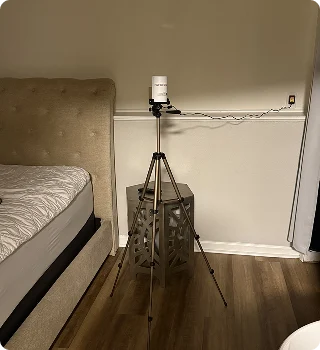
Either way, the result is the average radon concentration over the test period, in pCi/L. For a detailed device-by-device comparison, see our guide to radon testing devices.
Short-term vs. long-term radon test
| Short-term test | Long-term test | |
|---|---|---|
| Length | 2 to 90 days (most run 2–7 days) | More than 90 days |
| Common devices | Charcoal canister, electret, continuous radon monitor | Alpha-track detector, electret, consumer digital monitor |
| What it tells you | A snapshot under closed-house conditions | A closer estimate of the year-round average you actually breathe |
| Best for | First screening, real estate deadlines, post-mitigation checks | Confirming a borderline result, knowing your true average |
| Weakness | Weather and season can swing the result | You wait months for an answer |
Radon levels change day to day and season to season. That’s why EPA suggests a short-term test first for speed, then a follow-up (another short-term or a long-term test) if the first result is 4.0 or higher. For more on test timing, read how long a radon test takes.
How to test for radon yourself: step by step
A DIY test can be a good first step. Follow these steps so the result means something:
- Get a kit. Hardware stores sell them, and Wisconsin’s 17 Radon Information Centers offer low-cost kits (Wisconsin DHS). Check that lab analysis is included.
- Close the house. Keep windows and outside doors closed for 12 hours before and during the test, except for normal coming and going. Don’t run whole-house fans.
- Pick the spot. Lowest livable level, in a room you use (not a bathroom, kitchen, laundry or sump area). Keep it away from exterior walls, drafts, vents and humidity.
- Place it right. Roughly 20 inches or more above the floor, where it won’t be bumped. Note the start date and time.
- Wait. Leave it for the full time on the instructions, at least 48 hours for a short-term test.
- Seal and send. Record the end time, seal it and mail it to the lab promptly. Charcoal kits lose accuracy if they sit.
- Read the result against EPA’s 4.0 pCi/L action level.
Winter is a good time to test in Wisconsin, since closed-house conditions happen naturally.
What a professional radon test looks like
A professional test follows the same rules but removes the guesswork. Here’s how ours works:
- Scheduling and instructions. Tests are usually placed within a few days. You get written closed-house instructions so you can start them 12 hours ahead.
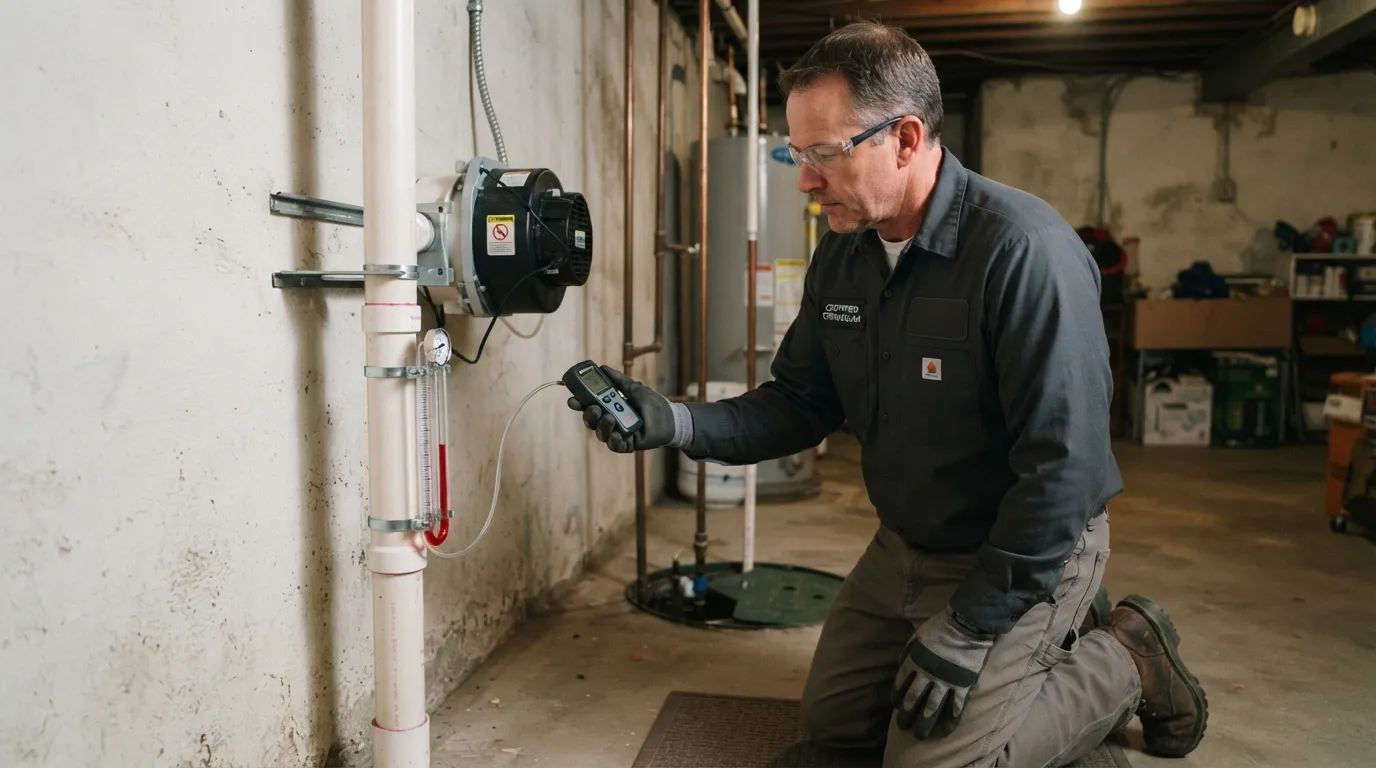
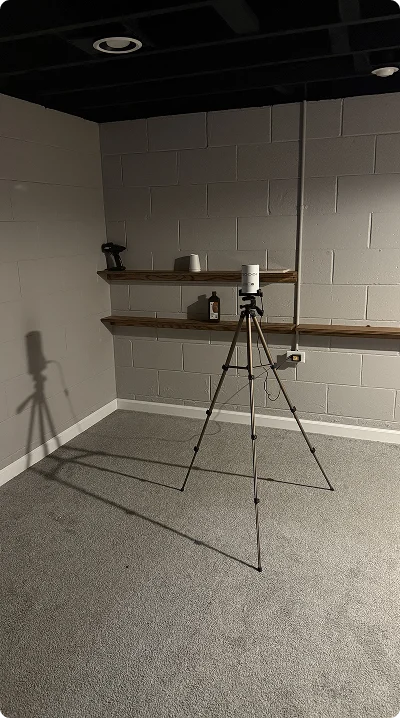
- Placement. Brian places a professional continuous radon monitor (Ecosense RadonEye Pro) on the lowest livable level, in the right spot and height.
- Monitoring. The monitor records hourly readings for at least 48 hours.
- Pickup and report. Brian picks up the monitor himself, and you get the average in pCi/L right after, with a written report included. The report is accepted for real estate transactions.
- Plain-language answer. If the level is low, that’s the end of it. If it’s high, we explain your options without pressure.
When does a professional test make more sense than a kit? Real estate deadlines, a borderline DIY result, checking a new mitigation system, or when you simply want the hourly data. Details are on our radon testing in Milwaukee page.
Reading your results: what to do next
EPA’s guidance, simplified:
| Your result | Next step |
|---|---|
| Short-term test below 4.0 pCi/L | No immediate action. Consider retesting in the future, especially after renovations. Between 2.0 and 3.9, consider a fix. |
| Short-term test 4.0 pCi/L or higher | Do a follow-up test: a long-term test for a better average, or a second short-term test if you need an answer sooner. |
| Long-term test 4.0 or higher | Fix the home. |
| Average of two short-term tests 4.0 or higher | Fix the home. |
| Real estate test 4.0 or higher | Common practice is to negotiate mitigation as part of the sale; DHS real estate guidance covers testing protocols. |
| After mitigation | Retest to confirm, then at least every 2 years (EPA). |
If you need to understand the number itself, our guide to pCi/L explains what each level means.
8 radon testing facts every homeowner should know
- Every home should be tested. EPA and Wisconsin DHS recommend it regardless of age, style or location.
- No test, no answer. Radon causes no symptoms and has no smell. You can’t tell by looking.
- Location matters. Test the lowest livable level, not a crawl space, closet or sump area.
- Conditions matter. Closed windows and doors 12 hours before and during short-term tests.
- Levels swing. Weather, wind, season and the heating system all move radon up and down.
- One test is a snapshot. A borderline short-term result is worth confirming.
- Neighbors don’t count. Next-door homes can test very differently.
- Retest over time. After mitigation, after finishing a basement, after major HVAC or window changes, and every 2 years with a system.
Radon testing in Wisconsin
About 1 in 10 Wisconsin homes has high radon, according to DHS. A few Wisconsin rules and resources shape how people test here:
- Real estate: testing isn’t required to sell a home in Wisconsin, but DHS highly recommends it. DHS real estate guidance calls for at least a 48-hour test under closed-house conditions starting 12 hours before, on the lowest livable level (DHS).
- Child care: since March 2023, Wisconsin DCF requires licensed child care providers to test for radon and mitigate above 4.0 pCi/L.
- Low-cost kits: 17 Radon Information Centers around the state offer affordable kits and advice.
- Season: a Wisconsin winter test reflects closed-house conditions you live with for months.
In growing suburbs like Franklin, where many families buy and sell homes with basements, radon tests often happen during inspections. Our Franklin, WI radon testing and mitigation page covers local service.
Get a radon test you can trust
Brian Thompson, an NRPP-certified radon measurement and mitigation professional, tests homes across Greater Milwaukee with professional continuous radon monitors. Clear results, a written report and an honest next step.
FAQ
Is radon testing really necessary?
Yes. EPA, the U.S. Surgeon General and Wisconsin DHS all recommend testing every home, because radon has no smell or symptoms and is the second leading cause of lung cancer in the U.S. About 1 in 10 Wisconsin homes has high radon. A test is the only way to know whether yours is one of them.
What is the most accurate way to test for radon?
A calibrated continuous radon monitor placed by a certified tester gives the most detailed short-term result, with hourly readings that show conditions during the test. For the truest year-round average, a long-term test of 90 days or more is best. Either way, accuracy depends on correct placement and closed-house conditions.
Short-term vs long-term radon test: which do I need?
Use a short-term test (2–90 days) when you need an answer quickly, like a home sale or a first screening. Use a long-term test (90+ days) to learn your home’s year-round average or to confirm a borderline result; we offer both. EPA suggests following a high short-term result with a second test before deciding on mitigation.
How often should you test for radon?
Test at least once in every home, and again after major renovations, finishing a basement or changing HVAC. If you have a mitigation system, EPA recommends retesting at least every 2 years to confirm it’s working. Retesting is also smart before you sell or buy a home.
Sources
- EPA: A Citizen’s Guide to Radon
- EPA: Radon
- Wisconsin DHS: Radon
- Wisconsin DHS: Radon and Real Estate
- NRPP