
Quick answer: A passive radon system is a sealed vent pipe from under the slab to the roof that relies on natural draft; an active system adds a fan that creates steady suction. Passive systems can lower radon somewhat, but active systems are more reliable. Brian Thompson of Milwaukee Radon Mitigation (NRPP-certified radon measurement and mitigation professional, West Allis, WI) tests passive systems and upgrades them when needed.
Key takeaways
- Passive = pipe only, no fan. Active = the same idea plus a fan running 24/7.
- Passive systems are usually part of radon-resistant new construction (RRNC).
- A passive system’s draft changes with the weather; an active system’s suction does not.
- If a passive home tests at or above 4.0 pCi/L, adding a fan is usually the fix (Wisconsin DHS).
- Test either way. Only a test shows whether the system is enough.
In this guide
- Passive vs active at a glance
- How a passive radon system works
- How an active radon system works
- Passive vs active in radon-resistant new construction
- When passive is enough, and when it is not
- Upgrading passive to active
- Cost differences
- Passive systems in Wisconsin weather
- FAQ
Passive vs active radon system at a glance
| Passive system | Active system | |
|---|---|---|
| Fan | None | Inline radon fan, 24/7 |
| What moves the air | Natural draft (warm air rising, wind) | The fan’s suction |
| Typical setting | New construction with RRNC features | Existing homes and upgraded new homes |
| Reliability | Varies with season and weather | Steady year-round |
| Running cost | None | Fan electricity |
| Noise | None | Low hum |
| Monitoring | Test results only | Manometer + test results |
| Upgrade path | Add a fan to the existing pipe | Resize or add suction points if needed |
How a passive radon system works
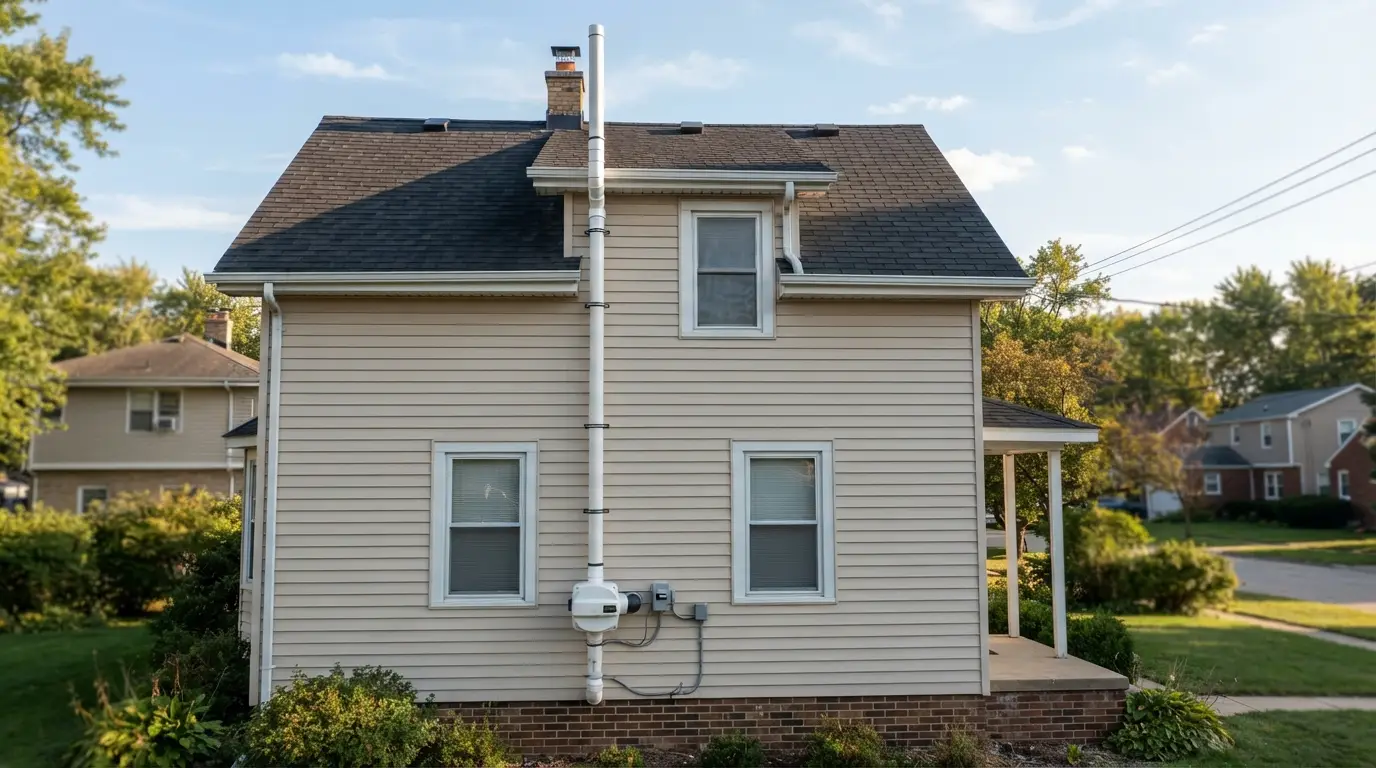
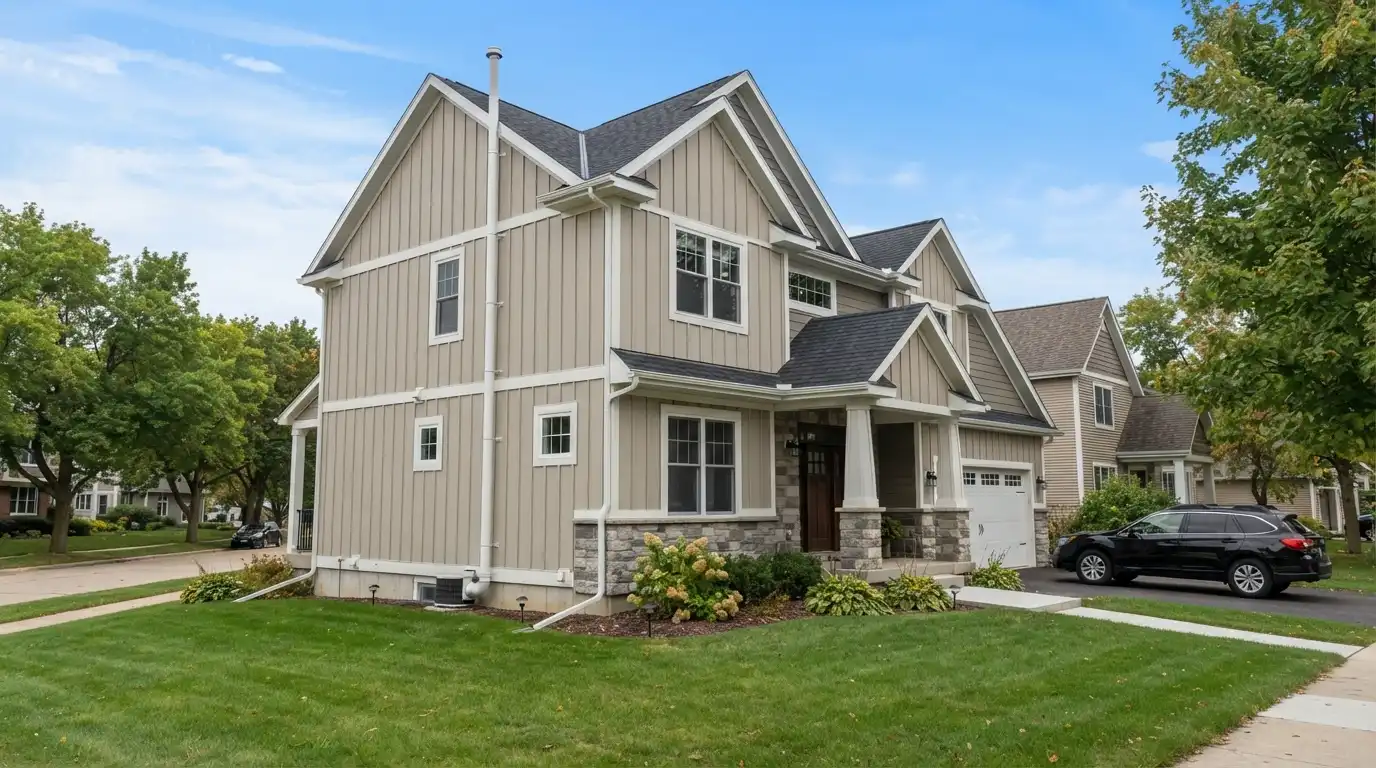
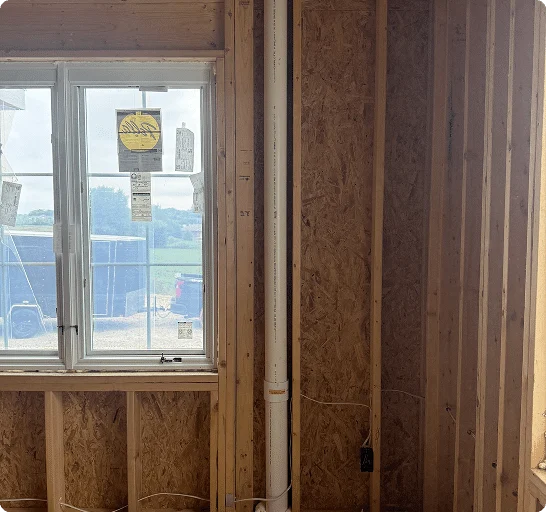
A passive system relies on the same physics that makes a chimney draw. Air inside the vent pipe, warmed as it rises through the house, is lighter than the cold air outside. It rises and exits at the roof, pulling a little soil gas from under the slab behind it. Wind across the roof can add some pull.
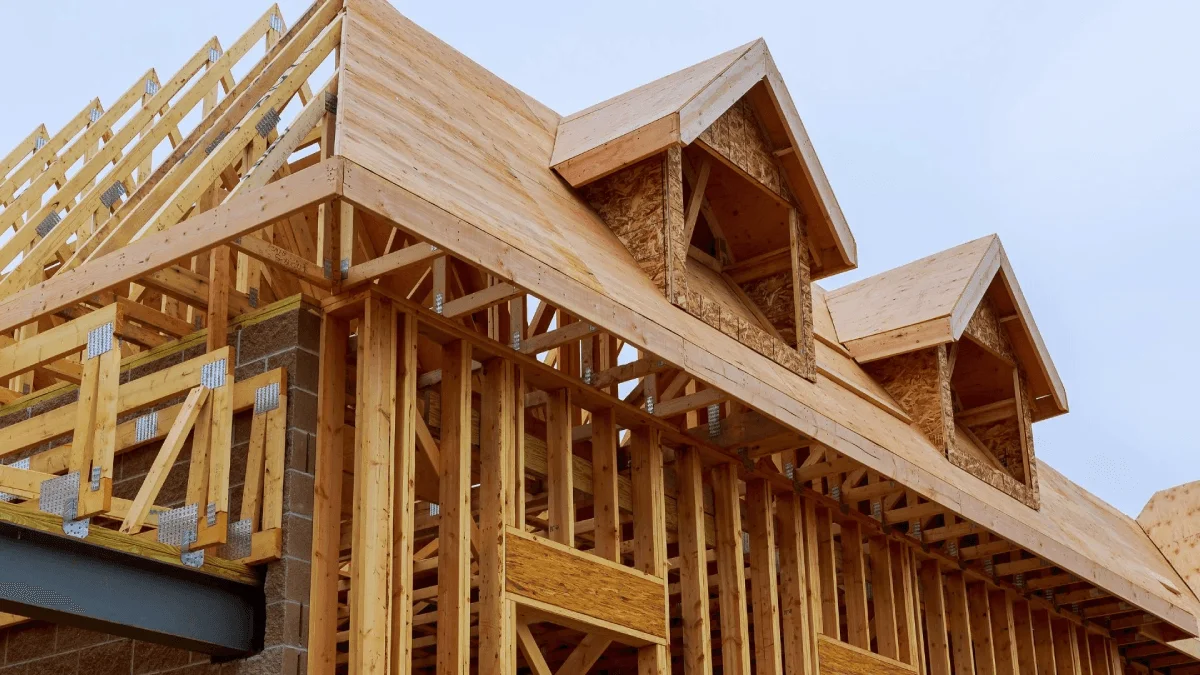
The system usually sits on top of RRNC features: a gravel layer under the slab, plastic sheeting over it, and sealed joints. Those features slow radon entry on their own, and the pipe gives soil gas a path out other than your basement.
The weakness is that natural draft is not constant. It is strongest when the house is much warmer than outside and weakest on mild days. A passive system has no gauge showing it is working.
How an active radon system works
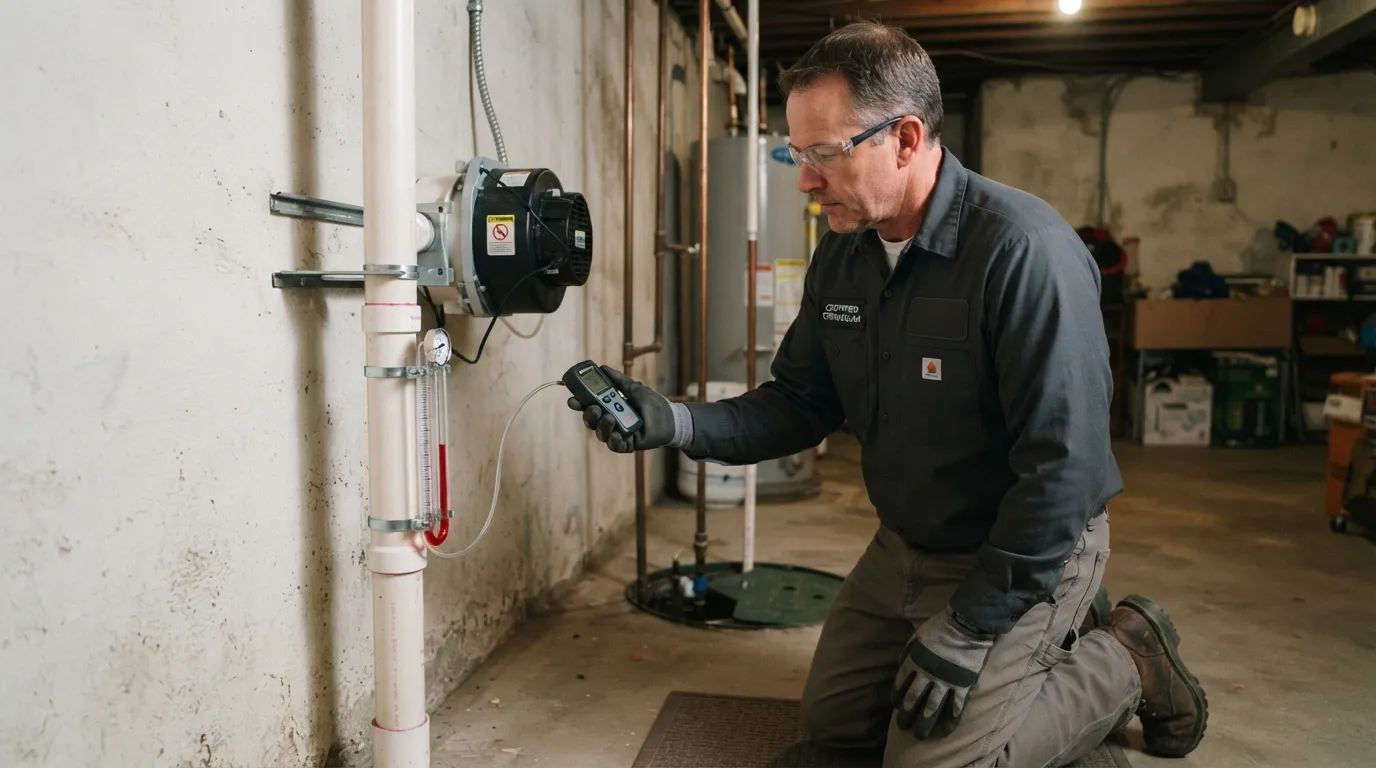
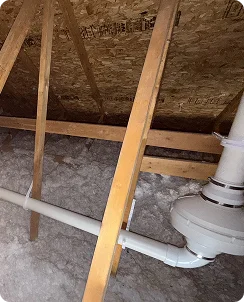
An active system adds an inline fan, mounted outside the living space, to the pipe. The fan creates a steady low-pressure zone under the slab so soil gas is pulled to the pipe regardless of weather. A manometer on the pipe shows suction at a glance.
Most retrofit systems in existing homes are active sub-slab depressurization (ASD), the method EPA describes as most common. Read the full walkthrough in how radon mitigation systems work.
Passive vs active in radon-resistant new construction
When a home is built radon-resistant, the builder typically installs a passive system and leaves an electrical junction box in the attic near the pipe. The idea, as EPA describes it, is simple: build the cheap parts in during construction, test after move-in, and add a fan only if the test calls for it.
That is why the question is rarely passive or active. In new construction, it is passive first, then active if needed. If you are buying or building, our post on radon in new construction explains when and how to test.
When passive is enough, and when it is not
A passive system is enough when a proper test, under closed-house conditions on the lowest livable level, comes back below the EPA action level of 4.0 pCi/L. EPA also suggests considering a fix between 2 and 4 pCi/L, so a reading in that range is worth a conversation.
Go active when:
- your test is 4.0 pCi/L or higher
- a summer or spring retest is noticeably higher than a winter one, showing the passive draft is weak in mild weather
- the basement is finished or used as a bedroom, so you want a margin below the action level
- you want a manometer that shows the system is working every day
- the home is a licensed child care setting: since March 2023, Wisconsin DCF requires licensed providers to test and mitigate above the EPA action level (see our daycare and school radon testing page)
Upgrading passive to active
Wisconsin DHS notes that in new buildings with piping installed, a contractor can add a fan to turn a passive system into an active one. A typical upgrade looks like this:
- Confirm the pipe. Check that it actually starts under the slab, is sealed, and runs uninterrupted to the roof. (Some passive pipes are capped, cut or never connected.)
- Pick the fan spot. Usually in the attic, near the junction box left by the builder.
- Install the fan inline, with couplings and support; a licensed electrician connects power.
- Seal the sump lid and obvious cracks if needed.
- Add a manometer and label.
- Retest no sooner than 24 hours after the fan starts.
See our radon-resistant new construction service for passive system upgrades in Greater Milwaukee.
Cost differences: passive vs active
| Item | Passive system | Active system / upgrade |
|---|---|---|
| Installed during new construction | Builder-dependent; quoted per job | n/a |
| Adding a fan to an existing passive pipe | n/a | Quoted per job; request a free quote |
| Full active retrofit (no RRNC) | n/a | Most homes $1,200 to $1,500 for a standard system; see how much does radon mitigation cost |
| Running cost | None | Fan wattage (about 40 to 120 W in Brian’s installs) × 24 × 365 ÷ 1,000 × your kWh rate |
The big saving with RRNC comes from not having to core the slab or dig a suction pit later. Full retrofit pricing is explained in how much does radon mitigation cost.
Passive systems in Wisconsin weather
Wisconsin’s climate is both the best and worst case for a passive system.
- Winter: a heated house and a frigid outdoors make the strongest natural draft of the year. Passive pipes tend to pull best when you need it most.
- Spring and fall: milder temperatures mean weaker draft. A passive system that tested fine in January may do less in May.
- Condensation: like any radon pipe, a passive pipe carries moist soil gas. Routing it through the warm interior of the house, as RRNC typically does, helps limit freezing at the top.
That seasonal swing is why a single winter test on a passive home does not tell the whole story. Wisconsin DHS reports that about 1 in 10 Wisconsin homes has high radon, so it is worth retesting in a different season, then every 2 years as EPA recommends.
We upgrade passive systems across the southwest suburbs and beyond, including radon mitigation in Hales Corners. Julissa L., who compared several companies, chose Brian for quick, knowledgeable communication and said he explained how the system works.
Have a passive pipe and a high test?
Adding a fan is usually the simplest fix. Brian will check your existing pipe and tell you what the upgrade involves.
FAQ
Do passive radon mitigation systems work?
Sometimes. A passive system can lower radon by giving soil gas a path out through the roof, especially in winter when natural draft is strongest. But its pull changes with the weather and it has no fan to keep suction steady. Test the home; if it is 4.0 pCi/L or higher, adding a fan usually solves it.
Do radon systems work?
Yes, when designed and installed correctly. Active sub-slab depressurization is the method EPA describes as most common, and our customers have seen drops from about 9.5 to 0.30 pCi/L and from about 7.1 to 1.1 pCi/L. In Brian’s experience, typical active-system results are below 2.0 pCi/L, with more than 90% of homes below 1.0 pCi/L. Passive systems are less predictable. Either way, a post-mitigation test is the proof.
What is the cost difference between passive and active?
A passive system has no running cost and is cheapest when built in during construction. An active system adds a fan, its electricity, and eventual fan replacement. Upgrading an existing passive pipe to active is quoted per job and usually costs far less than a full retrofit because the pipe is already in place.
Can I turn a passive radon system into an active one?
Yes, in most cases. Wisconsin DHS notes that a contractor can add a fan to existing piping in new buildings. The pipe must start under the slab and run unbroken to the roof, with the fan placed outside the living space, usually in the attic. A manometer is added, and the home is retested after 24 hours.
Sources
- EPA: Radon-Resistant Construction Basics
- EPA: A Citizen’s Guide to Radon
- EPA: Consumer’s Guide to Radon Reduction
- Wisconsin DHS: Radon